Living in Foggy Bottom

Mid-century co-ops and condominiums, including the Watergate, and a historic district of 19th-century brick rowhouses between the White House and the Potomac, with Foggy Bottom–GWU Metro and the Kennedy Center close by.

Foggy Bottom Market Snapshot

A high-level look at current pricing, demand, and sales activity in the Foggy Bottom real estate market.
$315,000

Median Sales Price

$452

Median Price Per Sq Ft

51

Median Days On Market

85

Annual Closed Sales

-25.9%

YoY Median Price Change

Foggy Bottom is an apartment market, and a co-op market in particular: more than half of recent sales were cooperatives. The snapshot covers every closed sale inside the neighborhood boundary over the trailing twelve months through September 2026 — 81 co-op and condominium sales and 4 rowhouses. Price per square foot uses interior living area.

Across all home types the median sale was $315,000 at about $452 per square foot, with a median of 51 days on market and sales averaging 91% of original list price. The 26% drop in the median is almost entirely mix: only 4 rowhouses sold this year versus 14 the year before. The apartment median itself eased only about 3% to $303,000, though price per square foot fell about 10% and homes took longer to sell.

Market data reflects recent 12-month activity. Individual buildings may vary.

What Would Your Home Sell For Here?

Get my personal read on your home’s value, built from recent sales nearby and the homes you’d compete with, not an algorithm. I reply within one business day. Free, and no obligation to list.

For Sale

Homes for Sale in Foggy Bottom

Every active Foggy Bottom listing, pulled live from Bright MLS.

Don’t see the right home?

We track private and off-market opportunities before they reach the MLS.

Recently Sold

Recently Sold in Foggy Bottom

Closed sales from the past 12 months — the comps that set today’s pricing.

Wondering what your home could sell for?

Get a pricing strategy built on these comps and current Foggy Bottom demand.

Living in Foggy Bottom

An overview of daily life in Foggy Bottom, what draws residents, and what sets it apart.
Foggy Bottom stretches from just west of the White House to the Potomac River, south of Pennsylvania Avenue and the West End and north of the National Mall. It is home to George Washington University, the State Department, and the Kennedy Center, and its residential blocks sit tucked among these institutions near the river. Most homes are in mid-century apartment buildings, and a large share are cooperatives. Potomac Plaza (1956) at 2475 Virginia Avenue, the Watergate complex completed in the late 1960s and early 1970s — including Watergate South (1971) at 700 New Hampshire Avenue — and a series of 1950s–1970s buildings along Virginia Avenue and 24th through 26th Streets hold most of the market. The Foggy Bottom Historic District, designated in 1987, preserves small two- and three-story brick rowhouses built between about 1870 and 1911 on streets such as 24th, 25th, and 26th, and G, H, and I Streets. Daily life is compact and walkable. A Whole Foods and restaurants cluster near the GWU campus on I Street, a farmers market has run on I Street on Wednesdays since 2005, and the Kennedy Center offers performances year-round. The Potomac waterfront, Thompson Boat Center, and Rock Creek trail are at the western edge. Foggy Bottom–GWU station on the Orange, Blue, and Silver Lines is on 23rd Street, and Georgetown, the West End, and downtown are all within walking distance. I enjoy showing Foggy Bottom because it offers co-op and condo values close to the Mall and the river, plus some of the city’s most charming small rowhouses.

Key Highlights:

  • Housing character — 1950s–1970s co-ops and condos (Watergate, Potomac Plaza) plus 1870–1911 rowhouses in the historic district
  • Green space — Potomac waterfront, Rock Creek trail, and the Kennedy Center grounds
  • Daily essentials — Whole Foods and restaurants near I Street, a Wednesday farmers market, and nearby Trader Joe's in the West End
  • Transit — Foggy Bottom–GWU Metro (Orange/Blue/Silver) on 23rd Street
  • Schools — DCPS boundaries vary by block; confirm any address with the DCPS school finder
  • Market character — about 85–110 sales a year, mostly co-ops and condominiums

Foggy Bottom Real Estate FAQs

Insight into the nuances of buying and selling in one of the country’s most complex urban markets.

It suits buyers who want to walk to the Metro, the Potomac, the Kennedy Center, and downtown, often at lower prices than nearby neighborhoods. Many buildings are co-ops, which have their own approval and financing rules.
Foggy Bottom is in Northwest DC between the White House area and the Potomac River, south of Pennsylvania Avenue and the West End and north of the National Mall.
Yes. Foggy Bottom–GWU station on the Orange, Blue, and Silver Lines is on 23rd Street near the GWU campus.
Mostly co-ops and condominiums in 1950s–1970s buildings, plus a small number of historic rowhouses. Of 85 sales in the past year, 81 were apartments and more than half of all sales were cooperatives.
Over the twelve months through September 2026 the median sale was $315,000 at about $452 per square foot. Apartment prices ranged from about $135,000 to more than $3 million.
Yes, many. Potomac Plaza and much of the Watergate are cooperatives. Co-ops typically require board approval, may limit financing, and bundle property taxes into the monthly fee.
The median home sold in about 51 days, and sales averaged about 91% of original list price, so buyers generally have time and room to negotiate.
See a performance at the Kennedy Center, walk or row along the Potomac from Thompson Boat Center, shop the Wednesday farmers market on I Street, and walk to Georgetown or the National Mall.

Location & Neighborhood

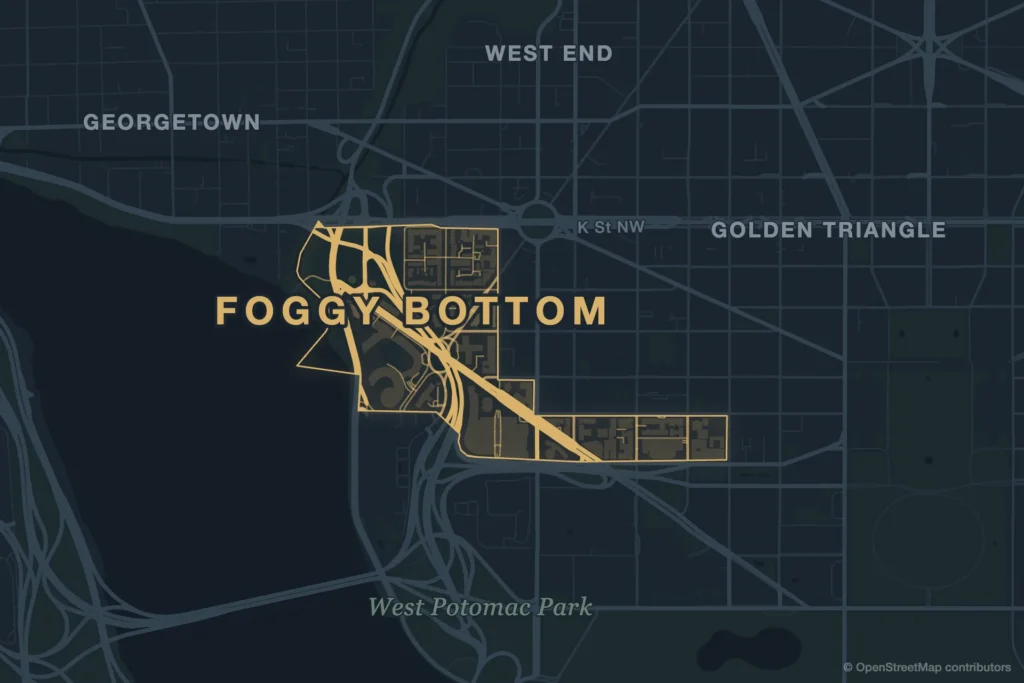
Between the White House and the Potomac River, south of Pennsylvania Avenue.
Foggy Bottom stretches from about 17th Street west to the Potomac River, bounded by Pennsylvania Avenue and the West End to the north and Constitution Avenue and the National Mall to the south. Virginia Avenue and New Hampshire Avenue hold most of the apartment buildings; 24th through 26th Streets and G, H, and I Streets hold the historic rowhouses.

Between the River and the Mall

Foggy Bottom–GWU station puts three Metro lines on 23rd Street, and Georgetown, the West End, and downtown offices are all walkable. The Kennedy Center, the State Department, and the Lincoln Memorial are at the neighborhood’s edges. Groceries and restaurants cluster around the GWU campus and I Street, and the Potomac waterfront, Rock Creek trail, and Thompson Boat Center are at the western edge for running, cycling, and rowing.

Neighboring Area:

  • West End — north, across Pennsylvania Avenue
  • Georgetown — northwest, across Rock Creek
  • Downtown — east, toward the White House
  • National Mall — south, across Constitution Avenue
  • Rosslyn, VA — west, across the Potomac

A Day In The Life - Snapshot

The quick details buyers ask about most.

Metro Access
Foggy Bottom–GWU (Orange/Blue/Silver) on 23rd Street is within about ten minutes’ walk of the whole neighborhood.
Walkability
Groceries, restaurants, the Kennedy Center, and the waterfront are all walkable, and Georgetown, the West End, and downtown are close by on foot.
Typical Home Types
Co-ops and condominiums in 1950s–1970s buildings such as the Watergate and Potomac Plaza, and small 19th-century brick rowhouses in the historic district.
Parking
Many buildings offer garage parking, often rented or sold separately; rowhouses rely mostly on residential permit parking. Street parking near GWU is tight.
Vibe
A mix of university energy near GWU and quiet residential blocks near the river, with the Kennedy Center and the Potomac as landmarks.
Best For
Buyers who want an apartment near the Metro, the river, and downtown, or a small historic rowhouse, and who are open to co-op ownership.

In-Depth Market Analysis

Foggy Bottom Market Insights

How pricing trends, absorption rates, and inventory levels are shaping buying and selling

Inventory & Absorption

About 85 homes sold here in the past year, down from about 110, almost all in apartment buildings. With a median of about seven weeks on market and only about one in eight sales at or above list, buyers currently have choice and negotiating room.

Pricing Dynamics

Co-ops and condos ranged from about $135,000 for studios to more than $3 million for large Watergate residences, with a median near $303,000 and about $451 per square foot. The few rowhouses that sold ranged from about $585,000 to $1.35 million.

Buyer Profile

Apartment buyers here compare buildings on monthly fees (which in co-ops often include property taxes), financing rules, views, and parking, and frequently weigh Foggy Bottom against the West End and Southwest Waterfront. Rowhouse buyers are competing for a very small supply.

Strategic Outlook

Expect a buyer-friendly apartment market through 2026. Sellers should price to recent sales in their own building, disclose fee and assessment details up front, and highlight views and updates. Historic rowhouses will remain scarce and should hold value well when they come up.

Market Position Overview:

Inventory Level: Balanced with selective competition

Negotiation Environment: Moderate flexibility

Typical Days on Market: 25-45 (well-priced units)

Rental Demand: Consistent due to transit proximity

Long- Term Outlook: Stable, walkability-driven value

Foggy Bottom Housing & Architecture

Mid-century co-ops and condominiums, the landmark Watergate, and a historic district of small 19th-century rowhouses.
The Watergate
The curving Watergate complex on the Potomac, built in phases and completed in the 1970s, combines co-op and condominium residences with a hotel and offices; Watergate South at 700 New Hampshire Avenue was completed in 1971.
Potomac Plaza Cooperative
A nine-story cooperative completed in 1956 at 2475 Virginia Avenue NW, one of the neighborhood’s most active buildings, close to the Metro and the Kennedy Center.
Mid-Century Apartment Buildings
A series of 1950s–1970s co-op and condo buildings along Virginia Avenue and 24th through 26th Streets offer larger layouts and balconies at moderate prices per square foot.
Historic Rowhouses
The Foggy Bottom Historic District, designated in 1987, protects two- and three-story brick rowhouses built between about 1870 and 1911, many on narrow streets near 25th and 26th.
George Washington University
GWU moved to Foggy Bottom in 1912 and its campus now shapes much of the neighborhood, with its own retail, dining, and a Metro station at its center.
The Kennedy Center
The John F. Kennedy Center for the Performing Arts, opened in 1971 on the Potomac, anchors the neighborhood’s southwestern edge.

Nearby neighborhoods

Close to Foggy Bottom

Ready to Talk About Your Next Move?

We’ll listen first, then recommend a strategy that fits your goals and timing.