Living In Falls Church

A small independent city of 1940s–60s Colonials and new mixed-use condominiums along Broad and Washington Streets, with the W&OD Trail and two Metro stations at its edges.

Falls Church Market Snapshot

A high-level look at current pricing, demand, and sales activity in the Falls Church real estate market.
$1,082,500

Median Sales Price

$519

Median Price Per Sq Ft

7

Median Days On Market

174

Annual Closed Sales

+10.9%

YoY Median Price Change

Falls Church is a mix of detached houses, condominiums, and townhouses in a small independent city. The snapshot covers every closed sale inside the City of Falls Church over the trailing twelve months through September 2026 — 76 detached houses, 65 condominiums, and 33 townhouses and semi-detached homes. Price per square foot uses interior living area.
Across all home types the median sale was $1,082,500 at about $519 per square foot, with a median of 7 days on market and sales averaging 100% of original list price. The median rose about 11% from the prior twelve months. Within segments, the detached median rose about 9% to $1.5 million and the condo median fell about 16% to $594,000.

Market data reflects recent 12-month activity. Individual buildings may vary.

What Would Your Home Sell For Here?

Get my personal read on your home’s value, built from recent sales nearby and the homes you’d compete with, not an algorithm. I reply within one business day. Free, and no obligation to list.

For Sale

Homes for Sale in Falls Church

Every active Falls Church listing, pulled live from Bright MLS.

Don’t see the right home?

We track private and off-market opportunities before they reach the MLS.

Recently Sold

Recently Sold in Falls Church

Closed sales from the past 12 months — the comps that set today’s pricing.

Wondering what your home could sell for?

Get a pricing strategy built on these comps and current Falls Church demand.

Living In Falls Church

An overview of daily life, character, and what draws residents to the neighborhood.
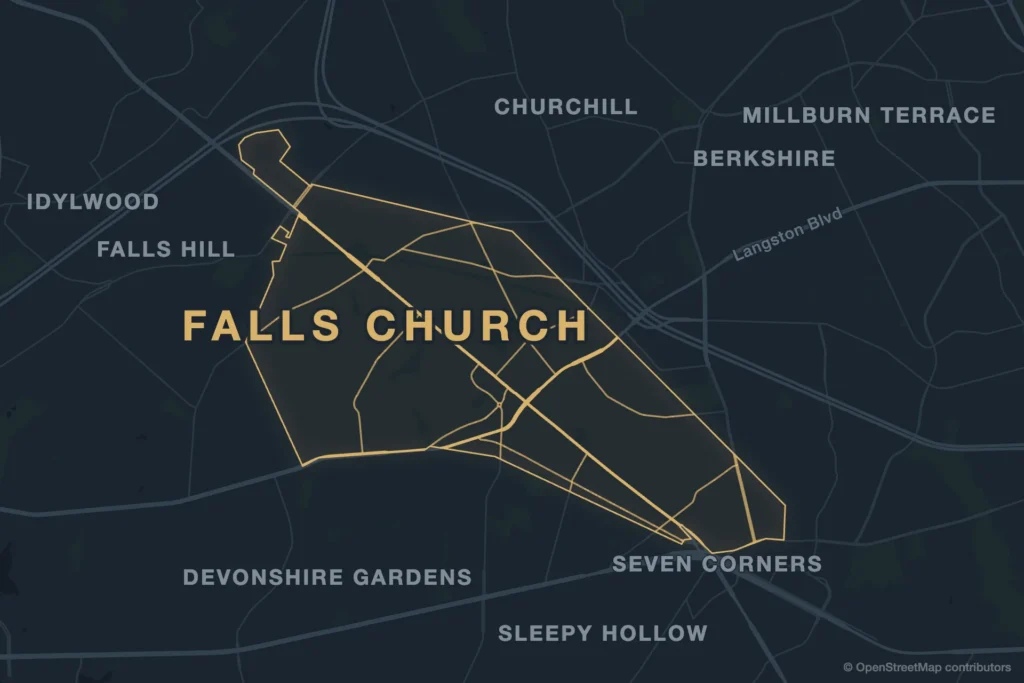
The City of Falls Church is an independent city of a little over two square miles, surrounded by Arlington and Fairfax counties about seven miles west of downtown DC. It has its own government and its own school division, Falls Church City Public Schools, and a small-city scale that sets it apart from the surrounding suburbs. Housing is mostly single-family: Cape Cods, bungalows, and Colonials from the 1920s through the 1950s, mid-century ramblers and split-levels, and newer infill houses. Along Broad Street and Washington Street, mixed-use buildings have added condominiums, apartments, and townhouses within walking distance of shops and restaurants. Daily life centers on Broad and Washington Streets, with local restaurants, the State Theatre music venue, and a Saturday farmers market at City Hall. The W&OD Trail runs through the city, and Cherry Hill Park and other parks are spread through the neighborhoods. East Falls Church and West Falls Church stations on the Orange and Silver Lines sit at the city’s edges, and I-66 and Routes 7 and 29 connect to Arlington, Tysons, and DC. Falls Church offers small-city living with a walkable core, Metro access, and a range of housing from older single-family homes to new mixed-use condos.

Key Highlights:

  • Independent city with its own school division
  • Walkable core along Broad and Washington Streets
  • Saturday farmers market and the State Theatre
  • Single-family homes plus newer mixed-use condos and townhouses
  • W&OD Trail and neighborhood parks
  • East and West Falls Church Metro (Orange/Silver)

Falls Church Real Estate FAQs

Insight into the nuances of buying and selling in one of the country’s most complex urban markets.

The city is served by its own school division, Falls Church City Public Schools. Homes with a Falls Church mailing address outside the city limits are served by Fairfax or Arlington schools, so confirm the jurisdiction and boundaries for any address.
The city’s small size, limited land, walkable core, Metro access, and independent services concentrate demand on a small supply of homes, which supports higher prices per square foot than many surrounding areas.
Downtown is walkable with local shops and restaurants. Neighborhoods are walkable for local needs. It’s small-town walkability.
Predominantly single-family colonial and contemporary homes from the 1960s-1980s. Modest lot sizes and square footage compared to outer suburbs.
Yes. The W&OD Trail runs through the city, and Cherry Hill Park, community centers, and neighborhood parks are spread through Falls Church.
Small-city and civic-minded, with a Saturday farmers market, community events, and a walkable core along Broad and Washington Streets.
Yes, most residents have cars. There’s no direct Metro access. However, downtown is walkable for local needs.
Falls Church’s limited supply, location, and Metro access have supported steady demand. As with any purchase, compare recent sales and condition before deciding.

Location & Neighborhood

A small independent city with a walkable center along Broad and Washington Streets.
GENERAL BOUNDARIES:
  • NORTH: Arlington County and Fairfax County (Lee Highway area)
  • EAST: Arlington County (East Falls Church)
  • SOUTH: Fairfax County (Seven Corners area)
  • WEST: Fairfax County (West Falls Church / I-66 area)

Falls Church's Central Location

The City of Falls Church is an independent city surrounded by Arlington and Fairfax counties, about seven miles west of downtown DC. Broad Street (Route 7) and Washington Street (Route 29) form its commercial core, with City Hall and many shops nearby. The city covers a little over two square miles, with the downtown core and surrounding single-family neighborhoods, and I-66 runs along its northern side.

Neighboring Area:

  • Arlington County — 5-10 minutes
  • Vienna — 10 minutes west
  • Fairfax County — adjacent all sides
  • Downtown DC — 25-30 minutes by car
  • Tysons — 15-20 minutes east

A Day In The Life - Snapshot

The quick details buyers ask about most.

Metro Access
East Falls Church and West Falls Church stations on the Orange and Silver Lines sit at the city’s edges, within walking or biking distance of many homes. Buses run along Broad and Washington Streets, and the W&OD Trail offers a bike route toward Arlington.
Walkability
The core along Broad and Washington Streets is walkable, with local shops, restaurants, and services, and the surrounding neighborhoods are within walking or biking distance for many errands.
Typical Home Types
Falls Church housing is mostly single-family: 1920s–1950s Cape Cods, bungalows, and Colonials, mid-century homes, and newer infill houses, plus condos, apartments, and townhouses in mixed-use buildings along Broad and Washington Streets.
Parking
Parking in Falls Church is adequate. Most homes have garages and driveways. Street parking is available but competitive in neighborhoods. Downtown has public parking. Parking is manageable. Car ownership is typical.
Vibe
Small-city and civic-minded, with a walkable core, local restaurants and music at the State Theatre, a Saturday farmers market, and quiet residential streets.
Best For
Buyers who want small-city living with a walkable core and Metro access, from a mixed-use condo on Broad Street to a single-family home on a residential street.

In-Depth Market Analysis

Falls Church Market Insights

How pricing trends, absorption rates, and inventory levels are shaping buying and selling

Inventory & Absorption

Inventory in the City of Falls Church is limited relative to demand because of its small size. Most single-family supply comes from resales, while mixed-use projects add condos and townhouses. Well-priced homes typically sell quickly.

Pricing Dynamics

Falls Church pricing is high relative to home size and age, reflecting limited supply, location, Metro access, and the city’s independent services. Newer and renovated homes command premiums.

Buyer Profile

Buyers here often compare the City of Falls Church with nearby Arlington and Fairfax neighborhoods that share a Falls Church mailing address, weighing jurisdiction, Metro access, lot size, and condition.

Strategic Outlook

For buyers: confirm whether a home is inside city limits, and compare recent sales on similar lots. For sellers: highlight updates, outdoor space, and proximity to Broad Street and Metro, and price to recent nearby sales.

Market Position Overview:

Inventory Level: Balanced with selective competition

Negotiation Environment: Moderate flexibility

Typical Days on Market: 25-45 (well-priced units)

Rental Demand: Consistent due to transit proximity

Long- Term Outlook: Stable, walkability-driven value

Falls Church Housing & Architecture

1940s–60s Colonials and Cape Cods on tree-lined streets, with new mixed-use condominiums along Broad and Washington Streets.
1940s–60s Colonials and Cape Cods
Brick and frame houses from the 1940s through the 1960s fill most residential streets.
Older Victorian and Early 1900s Houses
A smaller number of late-1800s and early-1900s houses survive near the historic center along Broad Street.
New Mixed-Use Condominiums
Buildings completed in the 2020s along Broad and Washington Streets add condominiums above shops and restaurants.
Townhouses
Townhouse communities near the commercial corridors offer a lower-maintenance option.
Broad and Washington Streets
The city’s two main streets cross at its center and are lined with shops and restaurants, with the State Theatre on North Washington Street.
Transit and Trails
East Falls Church and West Falls Church Metro stations (Orange/Silver) sit just outside the city limits, and the W&OD Trail runs through town.

Condo Buildings

Condo Buildings in Falls Church

Building-by-building guides with amenities, fees, recent sales and what's for sale now.

Nearby neighborhoods

Close to Falls Church

Ready to Talk About Your Next Move?

We’ll listen first, then recommend a strategy that fits your goals and timing.