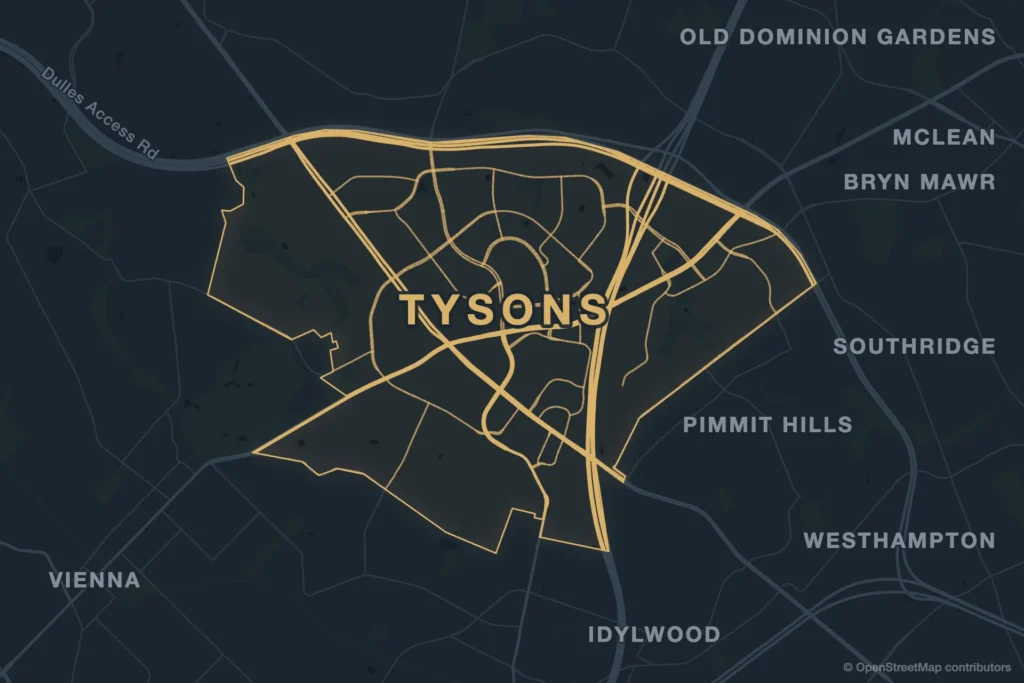
Living In Tysons

Northern Virginia’s largest employment and retail center, with high-rise condos, Tysons Corner Center and Galleria, and four Silver Line stations.

Tysons Market Snapshot

A high-level look at current pricing, demand, and sales activity in the Tysons real estate market.
$490,000

Median Sales Price

$419

Median Price Per Sq Ft

16

Median Days On Market

297

Annual Closed Sales

-9.3%

YoY Median Price Change

Tysons is mainly a condominium market, with townhouses and a small group of detached houses at its edges. The snapshot covers every closed sale inside the Tysons census-designated area over the trailing twelve months through September 2026 — 217 condominiums, 55 townhouses and semi-detached homes, and 25 detached houses. Price per square foot uses interior living area.

Across all home types the median sale was $490,000 at about $419 per square foot, with a median of 16 days on market and sales averaging 97% of original list price. The median fell about 9% from the prior twelve months. Within segments, the condo median fell about 5% to $410,000 and the townhouse median fell about 3% to $900,000.

Market data reflects recent 12-month activity. Individual buildings may vary.

What Would Your Home Sell For Here?

Get my personal read on your home’s value, built from recent sales nearby and the homes you’d compete with, not an algorithm. I reply within one business day. Free, and no obligation to list.

For Sale

Homes for Sale in Tysons

Every active Tysons listing, pulled live from Bright MLS.

Don’t see the right home?

We track private and off-market opportunities before they reach the MLS.

Recently Sold

Recently Sold in Tysons

Closed sales from the past 12 months — the comps that set today’s pricing.

Wondering what your home could sell for?

Get a pricing strategy built on these comps and current Tysons demand.

Living In Tysons

An overview of daily life, character, and what draws residents to the neighborhood.
Tysons is Northern Virginia’s largest business and retail district, located where I-495, Route 7, and Route 123 meet between McLean and Vienna. Once a car-oriented office and shopping hub, it has been transforming into a denser, more walkable urban center since the Silver Line opened four stations here in 2014. Housing is mostly mid- and high-rise condominiums and apartments, many completed in the last decade, with amenities such as fitness centers, pools, concierge service, and garage parking. Townhouse communities and single-family neighborhoods sit at the edges of Tysons and in neighboring McLean and Vienna. Tysons Corner Center and Tysons Galleria anchor a large concentration of shopping and dining, and newer mixed-use developments add restaurants, grocery stores, and entertainment, including Capital One Hall. Major employers include Capital One and many technology and consulting firms. McLean, Tysons, Greensboro, and Spring Hill stations on the Silver Line connect to Reston, Arlington, and downtown DC, and the Beltway and Dulles Toll Road provide regional road access. Tysons offers high-rise condo living with major shopping, employment, and four Metro stations at the door.

Key Highlights:

  • High-rise and mid-rise condos with building amenities
  • Major employment center with many large employers
  • Four Silver Line stations: McLean, Tysons, Greensboro, Spring Hill
  • Tysons Corner Center and Tysons Galleria
  • Restaurants, grocery stores, and Capital One Hall
  • Ongoing mixed-use development

Tysons Real Estate FAQs

Insight into the nuances of buying and selling in one of the country’s most complex urban markets.

Tysons offers high-rise condo living with major shopping, a large employment base, and four Silver Line stations, which makes it a convenient base for commuting across Northern Virginia.
Only modern apartment and condo buildings. Units are typically 1-2 bedrooms with contemporary finishes. No rowhouses or single-family homes.
Increasingly. The neighborhood is becoming more pedestrian-oriented as development continues. Some areas have good walkability; others remain car-dependent.
About 25-35 minutes to Downtown DC via the Silver Line, depending on starting point and destination.
Tysons prices are moderate for Northern Virginia, lower than some Arlington neighborhoods but competitive for new construction.
Tysons is served by Fairfax County Public Schools. Assignments vary by address, so confirm any home with the FCPS boundary locator.
Most residents have cars, though Silver Line provides good transit access. Many use cars for convenience despite transit access.
Tysons’ employment hub status, Metro access, and modern buildings make it attractive for investors. However, competition is increasing as new buildings open.

Location & Neighborhood

Northern Virginia’s major mixed-use employment and retail destination.
GENERAL BOUNDARIES:
  • NORTH: Route 123 and the Dulles Toll Road
  • EAST: McLean (I-495 / Route 123 area)
  • SOUTH: Vienna and Dunn Loring (Gallows Road area)
  • WEST: Wolf Trap (Route 7 / Spring Hill Road area)

Tysons' Employment Hub Position

Tysons sits in central Fairfax County immediately west of McLean, approximately 15-20 miles west of Arlington. The neighborhood is anchored by the Tysons Corner shopping mall and surrounding retail and office developments. The Silver Line runs east-west through Tysons with multiple stations providing transit connectivity. Tysons encompasses significant square mileage with mixed office, retail, and residential development. Major roads including Route 7, Route 50, and the Dulles Toll Road provide regional connectivity. This creates a major employment and commercial hub.

Neighboring Area:

  • McLean — east
  • Vienna — southwest
  • Reston — about 10–15 minutes west
  • Falls Church — about 15 minutes southeast
  • Downtown DC — about 25–35 minutes by Metro

A Day In The Life - Snapshot

The quick details buyers ask about most.

Metro Access
Tysons has excellent Silver Line Metro access with multiple stations serving the neighborhood. The Metro provides access to Reston, other Northern Virginia neighborhoods, and DC (20-30 minutes to Downtown DC). Many residents use Metro for commuting; others drive. The Metro has transformed Tysons’ accessibility.
Walkability
Tysons is increasingly walkable as development continues. The neighborhood is becoming more pedestrian-oriented around Metro stations and retail areas. However, it’s mixed—some areas remain car-dependent while others have developed pedestrian infrastructure. Walkability is improving but varies by location.
Typical Home Types
Tysons housing is exclusively modern apartment and condo buildings, most completed or under development in recent years. Units are typically 1-2 bedrooms with contemporary finishes. Buildings include modern amenities. Townhouses provide limited alternatives. Single-family homes are absent.
Parking
Parking in Tysons is built into buildings and lots. Most apartments include parking with fees. Street parking is limited. Parking is generally available but may require fees. Most residents have cars or use ride-sharing.
Vibe
Urban and busy around the Metro stations and shopping centers, with ongoing construction and a growing number of parks, restaurants, and residential towers.
Best For
Buyers who want a high-rise condo with amenities near major shopping, Northern Virginia employers, and Silver Line stations.

In-Depth Market Analysis

Tysons Market Insights

How pricing trends, absorption rates, and inventory levels are shaping buying and selling

Inventory & Absorption

Tysons’ inventory is constantly expanding with new construction regularly adding units. The neighborhood’s employment hub status and Metro access drive strong demand. Absorption is strong but competitive—many new buildings are opening simultaneously. The market is dynamic and supply-driven.

Pricing Dynamics

Tysons pricing reflects modern buildings, employment hub status, and Silver Line access. Newer buildings command premium prices; established buildings offer relative value. The market has appreciated as Metro access and employment have increased. Prices support continued development.

Buyer Profile

Buyers here compare buildings closely on fees, amenities, views, parking, and walking distance to Metro, and often weigh Tysons against Reston Town Center, Merrifield, and Arlington.

Strategic Outlook

For buyers: compare buildings on fees, reserves, amenities, and Metro proximity, and review recent sales in the same building. For sellers: highlight views, updates, amenities, and Metro access, and price to recent comparable sales.

Market Position Overview:

Inventory Level: Balanced with selective competition

Negotiation Environment: Moderate flexibility

Typical Days on Market: 25-45 (well-priced units)

Rental Demand: Consistent due to transit proximity

Long- Term Outlook: Stable, walkability-driven value

Tysons Housing & Architecture

Condominium buildings from the 1970s onward and newer towers near four Silver Line stations, with townhouses at the edges.
1970s–90s Condominium Communities
Mid-rise and high-rise condominiums from the 1970s through the 1990s make up most sales and offer larger layouts at moderate prices.
Newer Towers
Buildings completed since the Silver Line opened in 2014 add full-service condominiums near the stations.
Townhouses
Townhouse communities near the edges of Tysons offer multi-level homes with garages.
Detached Houses at the Edges
A small number of detached houses from neighboring McLean and Vienna fall inside the boundary.
Tysons Corner Center and Galleria
Tysons Corner Center, opened in 1968, and Tysons Galleria are among the region’s largest shopping destinations.
Four Silver Line Stations
McLean, Tysons, Greensboro, and Spring Hill stations opened in 2014 and connect Tysons to DC and Dulles Airport.

Condo Buildings

Condo Buildings in Tysons

Building-by-building guides with amenities, fees, recent sales and what's for sale now.

Nearby neighborhoods

Close to Tysons

Ready to Talk About Your Next Move?

We’ll listen first, then recommend a strategy that fits your goals and timing.