Living In Clarendon

A walkable Orange and Silver Line urban village with restaurants, shops, and live music along Wilson Boulevard, surrounded by condos, garden apartments, and tree-lined residential streets.

Clarendon Market Snapshot

A high-level look at current pricing, demand, and sales activity in the Clarendon real estate market.
$763,450

Median Sales Price

$675

Median Price Per Sq Ft

10

Median Days On Market

78

Annual Closed Sales

+18.4%

YoY Median Price Change

Clarendon is mainly a condominium market around the Clarendon Metro, with townhouses and detached houses on the surrounding streets. The snapshot covers every closed sale inside the neighborhood boundary over the trailing twelve months through September 2026 — 56 condominiums, 11 townhouses and semi-detached homes, and 11 detached houses. Price per square foot uses interior living area.

Across all home types the median sale was $763,450 at about $675 per square foot, with a median of 10 days on market and sales averaging 99% of original list price. The median rose about 18% from the prior twelve months. Within segments, the condo median rose about 27% to $672,000 and the detached median rose about 61% to $2.5 million.

Market data reflects recent 12-month activity. Individual buildings may vary.

What Would Your Home Sell For Here?

Get my personal read on your home’s value, built from recent sales nearby and the homes you’d compete with, not an algorithm. I reply within one business day. Free, and no obligation to list.

For Sale

Homes for Sale in Clarendon

Every active Clarendon listing, pulled live from Bright MLS.

Don’t see the right home?

We track private and off-market opportunities before they reach the MLS.

Recently Sold

Recently Sold in Clarendon

Closed sales from the past 12 months — the comps that set today’s pricing.

Wondering what your home could sell for?

Get a pricing strategy built on these comps and current Clarendon demand.

Living In Clarendon

An overview of daily life, character, and what draws residents to the neighborhood.
Clarendon is one of Arlington’s busiest urban villages, centered on the Clarendon Metro station along Wilson and Clarendon Boulevards. Restaurants from casual to upscale, shops, fitness studios, and live music venues line the corridor, and Market Common adds grocery, retail, and dining. Housing near the Metro is mostly mid- and high-rise condominiums and apartments, many built since the 1990s, while garden-style condos from the mid-20th century and townhouses fill the surrounding blocks. Just beyond, neighborhoods such as Lyon Park, Ashton Heights, and Lyon Village offer bungalows, Colonials, and newer single-family homes. Nearly everything is walkable: groceries, restaurants, fitness, parks, and services are within a few blocks of the station, and the Custis Trail runs along I-66 to the north. Clarendon station on the Orange and Silver Lines connects directly to Rosslyn, downtown DC, Ballston, and Tysons, and Route 50 and I-66 are close by. Clarendon offers condo and townhouse living in the middle of one of the region’s most active dining and retail districts, with residential streets a short walk away.

Key Highlights:

  • Steps from Clarendon Metro (Orange/Silver)
  • Wilson Boulevard dining, retail, and Market Common
  • Mid- and high-rise condos, garden condos, and townhouses
  • Highly walkable, with the Custis Trail nearby
  • Active nightlife and events along the corridor
  • Single-family neighborhoods within walking distance

Clarendon Real Estate FAQs

Insight into the nuances of buying and selling in one of the country’s most complex urban markets.

Yes. Wilson and Clarendon Boulevards have many bars, restaurants, and live music venues, and the blocks closest to them are busy at night, especially on weekends. Buyers who prefer quiet evenings often look a few blocks off the main corridor.
Most Clarendon housing is apartments or condos in mid-rise buildings. Units are typically 1-2 bedrooms, 600-900 square feet. Buildings range from basic 1960s garden apartments to modern luxury condos. Most units are owner-occupied or investor rentals.
Extremely. Wilson Boulevard is pedestrian-friendly with shops, restaurants, and services within steps. Most daily needs are accessible on foot. The neighborhood is genuinely walkable by any urban standard.
Walkability, Metro access, dining, and nightlife drive demand. The neighborhood offers urban convenience and energy. However, Clarendon prices are lower than some Arlington neighborhoods because units are smaller and older construction is common.
Side streets off Wilson Boulevard are quieter, but Clarendon’s overall vibe is social and energetic. If you seek suburban quiet, other Arlington neighborhoods might be better suited.
Clarendon is one of Arlington’s most active areas, with a high share of condominiums and apartments near the Metro. Housing ranges from studios to townhouses, with single-family homes on the surrounding streets.
Many residents don’t own cars—Metro access is excellent and walkability is strong. However, parking is available through apartment buildings or permit programs if you drive occasionally.
Clarendon’s walkability, Metro access, and strong rental market make it attractive to investors and owner-occupants. The neighborhood has appreciated steadily and continues attracting demand. However, prices reflect this desirability.

Location & Neighborhood

Arlington’s most walkable urban village, centered on Wilson Boulevard.
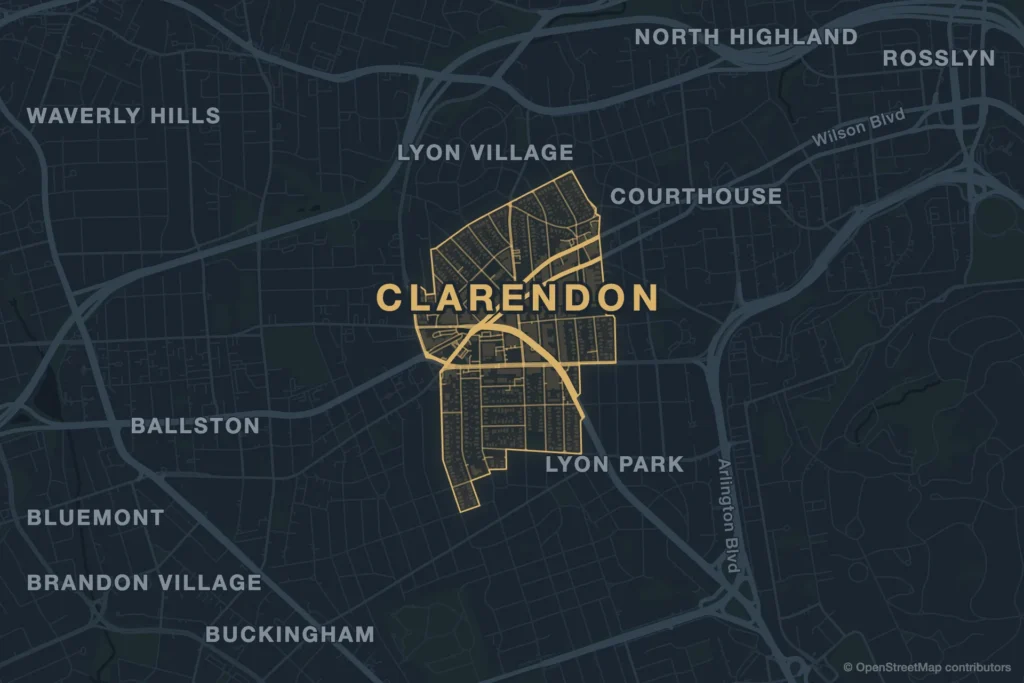
GENERAL BOUNDARIES:
  • NORTH: 13th Street North / Lyon Village
  • EAST: North Veitch Street (Courthouse beyond)
  • SOUTH: Arlington Boulevard (Route 50)
  • WEST: North Kirkwood Road / Washington Boulevard (Virginia Square beyond)

Clarendon's Central Location

Clarendon sits in central Arlington, immediately west of the Ballston neighborhood and east of Court House. The Orange Line runs north-south through the neighborhood, with the Clarendon Metro station at Wilson Boulevard and North Barton Street serving as the neighborhood’s social center. The neighborhood extends roughly from North Quincy Street (south) to North Highland Street (north), and from North Courthouse Road (west) to North Veitch Street (east). This relatively compact footprint makes Clarendon feel manageable and walkable in ways larger neighborhoods cannot.

Neighboring Area:

  • Ballston — 5-10 minutes east by Metro or car
  • Court House — immediately west, 10-15 minutes walk
  • Rosslyn — 10-15 minutes by Metro
  • Downtown DC — 15-20 minutes by Metro

A Day In The Life - Snapshot

The quick details buyers ask about most.

Metro Access
The Orange Line Metro station sits at the heart of Clarendon, making this neighborhood transit-dependent in the best way. Most residents walk to Metro in 5-10 minutes. Downtown DC is reachable in 15-20 minutes; Ballston and Rosslyn are 5-10 minutes away by train. Many Clarendon residents forgo cars entirely.
Walkability
Clarendon is one of Arlington’s most walkable neighborhoods. Wilson Boulevard is the commercial spine, lined with restaurants, shops, and services. Residential side streets are tree-lined and pedestrian-friendly. Most daily needs are accessible on foot. The neighborhood has strong sidewalk infrastructure and feels genuinely walkable, not just by suburban standards but by any urban measure.
Typical Home Types
Clarendon housing is predominantly mid-rise apartment buildings and garden-style condos, many built in the 1960s-1980s. These are typically 3-5 stories with modest units and shared amenities. Newer buildings are taller with more modern finishes. Single-family rowhouses are rare; most residents live in multi-unit buildings. A few older Craftsman rowhouses survive on side streets.
Parking
Parking in Clarendon is challenging but manageable. Most apartment buildings include parking, though spaces may require permits or fees. Street parking is permit-based and competitive. Many residents use Metro instead of driving, which reduces parking pressure. If you drive frequently, factor parking into your housing search.
Vibe
Clarendon is energetic, youthful, and social. The neighborhood feels like a place where people gather intentionally—restaurants and bars are crowded, sidewalks are animated, and there’s a sense of things happening. It’s urban without being gritty, fun without being frivolous. Residents tend to be outgoing and community-minded.
Best For
Buyers who want to walk to restaurants, shopping, and Metro, from a condo near the station to a townhouse or house on a nearby residential street.

In-Depth Market Analysis

Clarendon Market Insights

How pricing trends, absorption rates, and inventory levels are shaping buying and selling

Inventory & Absorption

Clarendon’s inventory is dominated by apartments and condos in established mid-rise buildings. New construction adds limited units due to zoning constraints. Absorption is strong—the neighborhood’s walkability and Metro access drive consistent demand. The rental market is robust, suggesting steady investor interest. Condo inventory turns over regularly but is competitive.

Pricing Dynamics

Clarendon pricing reflects strong demand for walkability and Metro access. Newer buildings command premium prices, while mid-century garden condos offer more value per square foot. Nearby townhouses and single-family homes are limited and sell at a premium.

Buyer Profile

Condo buyers here compare buildings on fees, amenities, parking, and noise, and often weigh Clarendon against Courthouse, Ballston, and Rosslyn. House buyers on the surrounding streets focus on lot, condition, and walking distance to the Metro.

Strategic Outlook

For buyers: Clarendon offers walkability and energy at more moderate prices than surrounding neighborhoods. Understand that you’re buying urban living in smaller units. Location and walkability are your primary assets. For sellers: your walkability and Metro access are your strongest selling points. Price competitively and highlight lifestyle benefits.

Market Position Overview:

Inventory Level: Balanced with selective competition

Negotiation Environment: Moderate flexibility

Typical Days on Market: 25-45 (well-priced units)

Rental Demand: Consistent due to transit proximity

Long- Term Outlook: Stable, walkability-driven value

Clarendon Housing & Architecture

Condominium buildings from the 2000s above shops and restaurants, with 1920s–40s houses and townhouses on the edges.
2000s Condominium Buildings
Most homes are in mid-rise and high-rise condominium buildings completed in the 2000s along Wilson and Clarendon Boulevards, many above ground-floor shops.
Market Common Clarendon
The mixed-use center that opened in 2001 combines shops and restaurants with homes, and set the pattern for the blocks around it.
Historic Clarendon Storefronts
Low-rise commercial buildings from the early and mid-1900s along Wilson Boulevard keep the older main-street character of the area.
Townhouses
Townhouse communities on the side streets offer multi-level homes with garages within a few blocks of the Metro.
Detached Houses at the Edges
Bungalows, Colonials, and newer houses from adjacent Lyon Village and Ashton Heights fall within the boundary and set the top of the price range.
Metro Access
Clarendon station (Orange/Silver) is at the center, with Court House and Virginia Square stations each about a 10-minute walk.

Nearby neighborhoods

Close to Clarendon

Ready to Talk About Your Next Move?

We’ll listen first, then recommend a strategy that fits your goals and timing.