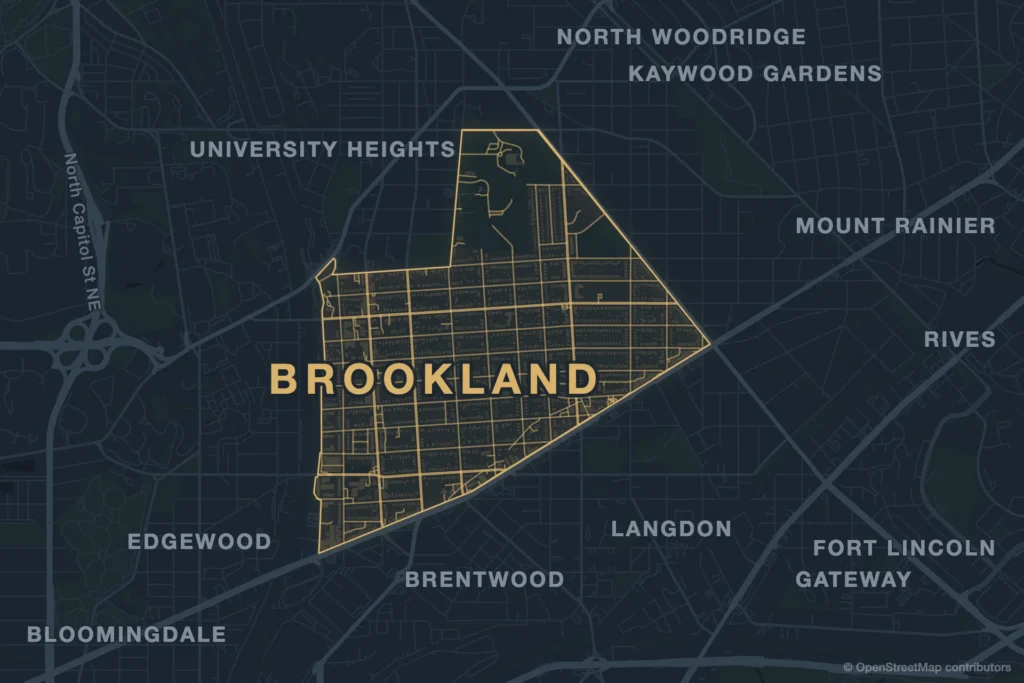
Living In Brookland

Brookland pairs early-20th-century detached homes and rowhouses with a Red Line station, the Metropolitan Branch Trail, and the walkable retail of Monroe Street Market — in Northeast DC beside Catholic University.

Brookland Market Snapshot

A high-level look at current pricing, demand, and sales activity in the Brookland real estate market.
$735,000

Median Sales Price

$384

Median Price Per Sq Ft

23

Median Days On Market

107

Annual Closed Sales

-11.4%

YoY Median Price Change

Brookland is a detached-house market with sizable rowhouse and condominium segments. The snapshot covers every closed sale inside the neighborhood boundary over the trailing twelve months through September 2026 — 63 detached houses, 32 rowhouses and semi-detached homes, and 12 condominiums. Price per square foot uses interior living area.

Across all home types the median sale was $735,000 at about $384 per square foot, with a median of 23 days on market and sales averaging 97% of original list price. The median fell about 11% from the prior twelve months. Within segments, the detached median fell about 3% to $910,000 and the rowhouse median fell about 2% to $604,000. Much of the overall change reflects the mix of homes that sold rather than a broad shift in values.

Market data reflects recent 12-month activity. Individual buildings may vary.

What Would Your Home Sell For Here?

Get my personal read on your home’s value, built from recent sales nearby and the homes you’d compete with, not an algorithm. I reply within one business day. Free, and no obligation to list.

For Sale

Homes for Sale in Brookland

Every active Brookland listing, pulled live from Bright MLS.

Don’t see the right home?

We track private and off-market opportunities before they reach the MLS.

Recently Sold

Recently Sold in Brookland

Closed sales from the past 12 months — the comps that set today’s pricing.

Wondering what your home could sell for?

Get a pricing strategy built on these comps and current Brookland demand.

Living In Brookland

An overview of daily life, character, and what draws residents to the neighborhood.
Brookland is an established residential neighborhood in Northeast Washington, set on a rise east of the Red Line and anchored by the Catholic University of America. It remains one of the District’s most distinctly residential pockets, defined by porch-front houses on tree-lined streets. The housing stock is predominantly detached. Over the past twelve months, about 59% of closed sales were detached single-family houses, with rowhouses, twins, and townhouses making up about 30% and condominiums about 11%. Most of the core was built in the 1920s and 1930s, in Colonial, Bungalow, Craftsman, and Federal styles, with a layer of newer infill and condo construction added over the past decade around the Metro and Monroe Street Market. Daily life centers on the Brookland-CUA Metro station and two retail corridors: 12th Street NE and the newer Monroe Street Market development, where the Arts Walk’s 27 studios, a weekend market, and restaurants draw foot traffic. The Metropolitan Branch Trail runs along the western edge, giving cyclists and walkers a car-free route toward NoMa and Union Station. For buyers, Brookland offers detached-home space and early-20th-century architecture at a lower price per foot than comparable neighborhoods closer to the core, with direct Red Line access roughly 10–15 minutes from Union Station and Metro Center.

Key Highlights:

  • Detached-dominant housing stock (about 59% of recent sales), with rowhouse and condo options
  • Brookland-CUA Metro (Red Line), about 10–15 minutes to Union Station and Metro Center
  • 1920s–1930s Colonials, Bungalows, and Craftsmans, plus newer infill
  • Monroe Street Market, 12th Street NE, and the Arts Walk for retail and dining
  • Metropolitan Branch Trail, Turkey Thicket, and Fort Bunker Hill Park
  • Lower price per square foot than neighborhoods closer to the city core

Brookland Real Estate FAQs

Insight into the nuances of buying and selling in one of the country’s most complex urban markets.

Brookland is a settled, primarily residential neighborhood in Northeast DC, built around the Catholic University of America. Streets are lined with detached homes and rowhouses, most dating to the 1920s and 1930s, while newer retail and condos have gathered around the Brookland-CUA Metro and Monroe Street Market. It offers more space and a quieter pace than neighborhoods closer to downtown, with a Red Line station for direct access to the core.
Mostly detached houses. Over the past twelve months, about 59% of closed sales were detached single-family homes, about 30% were rowhouses, twins, and townhouses, and about 11% were condominiums, most of them in newer buildings near the Metro and Monroe Street Market.
Brookland-CUA, on the Red Line, sits at the neighborhood’s western edge. The ride to Union Station or Metro Center typically runs about 10–15 minutes. Frequent bus routes along Michigan Avenue NE and 12th Street NE, plus the Metropolitan Branch Trail and Capital Bikeshare, round out everyday transit options.
Parts of it. The blocks around Monroe Street Market, 12th Street NE, and the Metro station are walkable for groceries, dining, and daily errands, and the Metropolitan Branch Trail offers a car-free route south toward NoMa. Quieter residential streets farther from the corridors are more car-friendly, and many detached homes have off-street parking — a contrast to denser neighborhoods closer to downtown.
Brookland sits in the mid-range of the DC market and offers detached-home space at a comparatively moderate price per foot. Over the trailing twelve months the blended median sale price was about $735,000, around $384 per square foot. Because the neighborhood spans condos, rowhouses, and large detached homes, that blended figure reflects a wide mix — detached houses alone ran closer to a $910,000 median.
It has been active but price-sensitive. About 107 homes closed over the trailing twelve months, with a median of 23 days on market and homes selling near asking (an average of about 97% of original list price). The blended median came in roughly 11% below the prior twelve-month period, but that swing largely reflects a shift in what sold — more attached homes — rather than a uniform drop in values.
Most homes date to the 1920s and 1930s. Colonial is the most common style, followed by Traditional, Bungalow, Craftsman, and Federal, with Victorian and Farmhouse/National Folk examples mixed in. Newer Contemporary infill and condo buildings have been added over the past decade, particularly near the Metro and Monroe Street Market, giving the neighborhood a layered streetscape rather than a single repeated design.
The Metropolitan Branch Trail runs along the western edge, connecting Brookland to NoMa and Union Station on foot or by bike. Turkey Thicket Recreation Center on Michigan Avenue has fields, courts and a playground, and Fort Bunker Hill Park adds wooded paths on the east side of the neighborhood.

Location & Neighborhood

A Northeast DC neighborhood with a university anchor and Red Line access.
GENERAL BOUNDARIES:
  • NORTH: Fern Street NE
  • EAST: Bladensburg Road NE
  • SOUTH: Michigan Avenue NE
  • WEST: South Dakota Avenue NE

A Residential Anchor in Northeast DC

Brookland sits in Northeast Washington, served by the Brookland-CUA Metro station on the Red Line and anchored by the Catholic University of America. The neighborhood rises east of the rail corridor and the Metropolitan Branch Trail, with Michigan Avenue NE and 12th Street NE forming its principal commercial and transit spines. The Red Line places Union Station, NoMa, and downtown within roughly 10–15 minutes, while the trail and bus network add car-free options. The university, Monroe Street Market, and 12th Street give Brookland a walk-to-retail character toward its center and quieter residential streets at its edges.

Neighboring Area:

  • Catholic University — adjacent, west-central
  • NoMa — south, about 10 minutes by Metro
  • Brentwood — southeast
  • Edgewood — southwest, across the rail corridor
  • Woodridge — east

A Day In The Life - Snapshot

The quick details buyers ask about most.

Metro Access
Brookland is served by the Brookland-CUA station on the Red Line, at the neighborhood’s western edge, with a typical 10–15 minute ride to Union Station and Metro Center. Frequent buses run along Michigan Avenue NE and 12th Street NE, and the Metropolitan Branch Trail and Capital Bikeshare add car-free options.
Walkability
Walkable around Monroe Street Market, 12th Street NE, and the Metro for daily errands and dining; quieter and more car-friendly on residential streets farther out. The Metropolitan Branch Trail provides a car-free route south toward NoMa and Union Station.
Typical Home Types
Predominantly detached single-family homes (about 59% of recent sales) in 1920s–1930s Colonial, Bungalow, and Craftsman styles, with rowhouses and twins (about 30%) and condominiums (about 11%) near the Metro and Monroe Street Market.
Parking
Many detached and rowhouse properties have off-street or alley parking, and street parking is generally available — an easier picture than denser neighborhoods closer to downtown. Newer condo buildings typically offer structured or assigned parking.
Vibe
Settled, residential, and historic, with Catholic University’s campus at its western edge. Energy concentrates around Monroe Street Market, the Arts Walk, and 12th Street NE, while the surrounding streets stay quiet and porch-front.
Best For
Buyers seeking detached-home space and historic architecture with direct Red Line access and a comparatively moderate price per foot — and those who value walk-to-retail pockets without giving up a quieter residential setting.

In-Depth Market Analysis

Brookland Market Insights

How pricing trends, absorption rates, and inventory levels are shaping buying and selling

Inventory & Absorption

Inventory is moderate, with roughly 19 homes active at the time of pull against about 122 closings a year. Well-priced, updated homes move quickly — a 23-day median — while overpriced or dated listings stall. Detached houses moved fastest, at a median of 17 days on market, while condominiums took about seven weeks, so pricing to recent comps matters most for attached homes and condos.

Pricing Dynamics

Price varies sharply by segment. Detached houses near the historic core command the top of the range (median ~$910,000), rowhouses and twins occupy the middle (~$603,000), and condominiums anchor the entry tier (~$402,000). Within each, size, lot, condition, and renovation drive the spread — so per-segment comps matter more than any district-wide figure.

Buyer Profile

Buyers here weigh detached-home space, lot size, and condition against Red Line and Metropolitan Branch Trail access, and often compare Brookland with Petworth, Woodridge, and Takoma. Condo and rowhouse buyers focus on walking distance to the Metro and Monroe Street Market.

Strategic Outlook

For sellers: price to recent comps in your specific segment — well-priced homes sell in about three weeks, while mispriced ones tend to linger or expire. For buyers: act decisively on well-priced inventory and compare within the detached, attached, or condo tier rather than to the blended median.

Market Position Overview:

Inventory Level: Balanced with selective competition

Negotiation Environment: Moderate flexibility

Typical Days on Market: 25-45 (well-priced units)

Rental Demand: Consistent due to transit proximity

Long- Term Outlook: Stable, walkability-driven value

Brookland Housing & Architecture

An early-20th-century residential neighborhood of detached homes and rowhouses, layered with newer infill around the Metro and Monroe Street Market.
Detached at the Core
Detached single-family houses are the most common home type in Brookland — about 59% of closed sales over the past twelve months — most built in the 1920s and 1930s. Colonial is the dominant style, with Bungalow, Craftsman, and Federal designs throughout, many carefully renovated while keeping their porch-front, period character.
An Architectural Mix
Beyond the prevailing styles, Brookland folds in Traditional, Victorian, Farmhouse/National Folk, and Contemporary homes, giving its streets a varied look rather than a single repeated design. Recent Contemporary infill adds a modern counterpoint to the historic stock.
Rowhouses & Twins
About 30% of recent sales were attached homes — rowhouses, twins, and townhouses — offering a more compact footprint and a lower entry point than the detached houses, with a recent median near $604,000.
Condos Near the Metro
About 11% of recent sales were condominiums, concentrated in newer buildings around Brookland-CUA and Monroe Street Market.
Catholic University & Campus Landmarks
The Catholic University of America’s campus and landmark buildings shape Brookland’s western and central blocks with green grounds and early-20th-century architecture, alongside the Monroe Street Market arts and retail district.
A Wide Price Range
Recent closed sales have run from about $225,000 for a small condo to $1,700,000 for a large detached home — about $384 per square foot blended. The breadth reflects a neighborhood with genuine options across condo, rowhouse, and detached segments.

Nearby neighborhoods

Close to Brookland

Ready to Talk About Your Next Move?

We’ll listen first, then recommend a strategy that fits your goals and timing.