Living in Columbia Heights

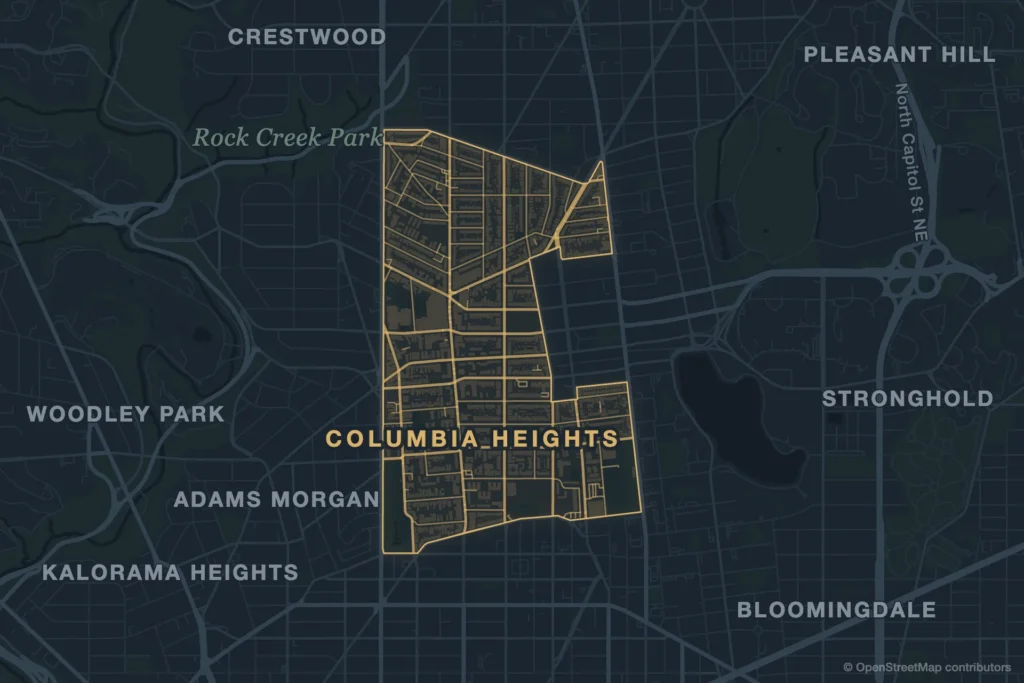
Early-1900s brick rowhouses and newer condominiums between 16th Street and Sherman Avenue, with a Green and Yellow Line Metro stop, 14th Street’s shops and restaurants, and Meridian Hill Park at the south edge.

Columbia Heights Market Snapshot

A high-level look at current pricing, demand, and sales activity in the Columbia Heights real estate market.
$710,000

Median Sales Price

$500

Median Price Per Sq Ft

23

Median Days On Market

196

Annual Closed Sales

+7.6%

YoY Median Price Change

Columbia Heights is a two-product market, split almost evenly between condominiums and rowhouses. The snapshot covers every closed sale inside the neighborhood boundary over the trailing twelve months through September 2026 — 99 condominium sales, 95 rowhouse and semi-detached sales, and 2 detached houses. Price per square foot uses interior living area.

Across all home types the median sale was $710,000 at about $500 per square foot, with a median of 23 days on market and sales averaging 96% of original list price. Part of the 7.6% rise in the all-types median is mix: condominiums made up a slightly smaller share of sales than the year before. Within each segment the picture is steadier — the condo median rose about 5.5% to $480,000, while rowhouses held at $875,000 but sold much faster, at a median of 15 days versus 30 a year earlier.

Market data reflects recent 12-month activity. Individual buildings may vary.

What Would Your Home Sell For Here?

Get my personal read on your home’s value, built from recent sales nearby and the homes you’d compete with, not an algorithm. I reply within one business day. Free, and no obligation to list.

For Sale

Homes for Sale in Columbia Heights

Every active Columbia Heights listing, pulled live from Bright MLS.

Don’t see the right home?

We track private and off-market opportunities before they reach the MLS.

Recently Sold

Recently Sold in Columbia Heights

Closed sales from the past 12 months — the comps that set today’s pricing.

Wondering what your home could sell for?

Get a pricing strategy built on these comps and current Columbia Heights demand.

Living in Columbia Heights

An overview of daily life in Columbia Heights, what draws residents, and what sets it apart.
Columbia Heights sits on the high ground north of Florida Avenue in Northwest DC, between 16th Street and Sherman Avenue, running up to Spring Road. It is one of the most complete urban neighborhoods in the city: a Metro station, a full grocery and big-box retail at its center, and blocks of rowhouses fanning out on every side. Most of the housing went up in a building boom between about 1900 and 1930, and it shows in the streetscape — long runs of two- and three-story brick rowhouses with porches and bay fronts on Harvard, Girard, Columbia Road, Kenyon, and Park Road. Many have since been converted into two- to four-unit condominiums, and a newer layer of mid-rise condo buildings sits closer to 14th Street and the Metro. Daily life orbits the intersection of 14th Street and Irving Street. DC USA holds the larger stores, Giant anchors groceries, and the restored 1924 Tivoli Theatre, now home to GALA Hispanic Theatre, anchors a stretch of restaurants and cafes that continues down 14th and along 11th Street. Meridian Hill Park, with its terraced cascade and Sunday drum circle, marks the southwest corner. The Columbia Heights Metro station on the Green and Yellow Lines has been the neighborhood’s hinge since it opened in 1999. The D50 and D5X buses run the length of 14th Street, and the D60 and D6X cover 16th Street toward downtown and Silver Spring. Many households here live comfortably without a car. I enjoy showing Columbia Heights because the choices are so clear: a rowhouse with a yard and a basement unit, or a condo a few minutes from the train, all inside one of the most walkable parts of the city.

Key Highlights:

  • Housing character — 1900s–1920s brick rowhouses, many split into condo flats, plus newer mid-rise condominiums near 14th Street
  • Green space — Meridian Hill (Malcolm X) Park, Banneker Recreation Center, and small pocket parks
  • Daily essentials — DC USA, Giant, and the 14th and Irving retail core, with restaurants along 14th and 11th Streets
  • Transit — Columbia Heights Metro (Green/Yellow); D50/D5X on 14th Street and D60/D6X on 16th Street
  • Schools — DCPS boundaries vary by block; confirm with the DCPS school finder for any address
  • Market character — about 200 sales a year, split evenly between condominiums and rowhouses

Columbia Heights Real Estate FAQs

Insight into the nuances of buying and selling in one of the country’s most complex urban markets.

It suits buyers who want city convenience: a Metro station, a full grocery, big-box retail, and dozens of restaurants within a few blocks, plus Meridian Hill Park at the south edge. The trade-off is density and activity around 14th Street.
Columbia Heights is in Northwest DC, generally between 16th Street and Sherman Avenue, from Florida Avenue north to Spring Road. Adams Morgan and Mount Pleasant are to the west, Park View to the east, and U Street to the south.
Yes. Columbia Heights station on the Green and Yellow Lines sits at 14th and Irving Streets. The D50 and D5X buses run along 14th Street and the D60 and D6X along 16th Street.
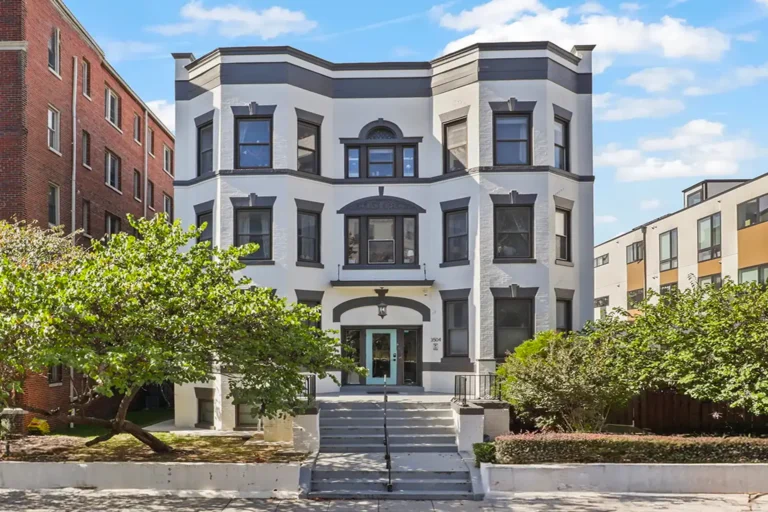
Mostly early-1900s brick rowhouses, many converted into two- to four-unit condominiums, plus mid-rise condo buildings from the 2000s onward. Detached houses are rare — two sold in the past year out of about 200 sales.
Over the twelve months through September 2026 the median sale was $710,000 at about $500 per square foot. Condominiums had a median of $480,000 and rowhouses $875,000.
The median home sold in about 23 days, and rowhouses moved faster at a median of 15 days. Roughly a third of sales closed at or above their original list price.
DC USA and the 14th and Irving shops cover errands; restaurants line 14th Street and 11th Street; GALA Hispanic Theatre programs the historic Tivoli; and Meridian Hill Park hosts weekend gatherings on its terraces.
Several DCPS elementary boundaries cross the neighborhood, and there are many public charter options nearby. Because assignments change block by block, confirm any address with the DCPS school finder.

Location & Neighborhood

Between 16th Street and Sherman Avenue, north of Florida Avenue, centered on the 14th and Irving Metro stop.
Columbia Heights is generally bounded by 16th Street NW to the west, Spring Road NW to the north, Sherman Avenue NW to the east, and Florida Avenue NW to the south. 14th Street is the commercial spine; Harvard, Girard, Columbia Road, Kenyon, Park Road, and Monroe Streets hold the rowhouse blocks, and 11th Street has its own small restaurant row.

Built Around the Train

Few DC neighborhoods are as well connected. Columbia Heights Metro puts the Green and Yellow Lines at the center of the neighborhood, with direct rides to U Street, Gallery Place, L’Enfant Plaza, and National Airport. Buses on 14th and 16th Streets fill in the north–south trips. Errands rarely need a car. Giant, DC USA’s larger stores, pharmacies, fitness studios, and hardware are all within a few blocks of the station, and the farmers market and small grocers add options through the week.

Neighboring Area:

  • Mount Pleasant — northwest, across 16th Street
  • Adams Morgan — southwest, past Meridian Hill Park
  • Park View — east, across Sherman Avenue
  • U Street Corridor — south, across Florida Avenue
  • Petworth — north, beyond Spring Road

A Day In The Life - Snapshot

The quick details buyers ask about most.

Metro Access
Columbia Heights station (Green/Yellow) at 14th and Irving is within about ten minutes’ walk of most of the neighborhood. D50/D5X run 14th Street; D60/D6X run 16th Street.
Walkability
Among the most walkable parts of DC: grocery, big-box retail, restaurants, and the Metro cluster around 14th and Irving, with rowhouse blocks a short walk in every direction.
Typical Home Types
Early-1900s brick rowhouses, many converted into two- to four-unit condominiums, plus mid-rise condo buildings from the 2000s onward. Detached houses are rare.
Parking
Residential permit parking on most blocks. Many rowhouses have rear alley pads or garages; newer condo buildings often sell deeded or assigned garage spaces separately.
Vibe
Busy and street-level around 14th Street, calmer on the porch-lined side streets. Meridian Hill Park’s terraces and the Tivoli’s theater programming give the neighborhood its landmarks.
Best For
Buyers who put transit and walkability first: condo flats minutes from the Metro, or rowhouses with basement units and rear parking on quieter blocks.

In-Depth Market Analysis

Columbia Heights Market Insights

How pricing trends, absorption rates, and inventory levels are shaping buying and selling

Inventory & Absorption

About 200 homes sell here each year, roughly half condominiums and half rowhouses, so there is usually something to see in each segment. Rowhouses are the tighter side of the market: they sold at a median of 15 days over the past year, and a well-presented house on a good block rarely lasts past its first two weekends.

Pricing Dynamics

Condominium prices run from the low $200,000s for studios to above $1 million for a handful of large penthouse units, with a median of $480,000 and most trading between $340,000 and $665,000. The middle half of rowhouse sales fell between about $730,000 and $1.04 million, and renovated houses with a rental unit reached about $1.65 million. Price per square foot is higher for condos ($543) than for rowhouses ($451).

Buyer Profile

Demand splits by product. Condo shoppers here tend to prioritize the Metro, in-unit laundry, and outdoor space, and they compare closely against U Street and Petworth. Rowhouse shoppers weigh basement rental units, rear parking, and renovation quality, and often pay a premium for a finished house over one that needs work.

Strategic Outlook

Expect rowhouses to stay competitive through 2026 given how quickly they are selling, especially renovated homes with income units. The condo segment is more balanced: sellers should price to recent sales in their own building or conversion, and buyers have room to negotiate on units without parking or outdoor space.

Market Position Overview:

Inventory Level: Balanced with selective competition

Negotiation Environment: Moderate flexibility

Typical Days on Market: 25-45 (well-priced units)

Rental Demand: Consistent due to transit proximity

Long- Term Outlook: Stable, walkability-driven value

Columbia Heights Housing & Architecture

A rowhouse neighborhood from the early 1900s, with a newer layer of condominiums around 14th Street and the Metro.
Porch-Front Rowhouses
The signature Columbia Heights house: a two- or three-story brick rowhouse from about 1905–1925 with a front porch, bay or turret front, and a deep lot. Harvard, Girard, Kenyon, and Park Road hold long, intact runs.
Condo Conversions
Many rowhouses have been split into two to four condominium flats, often with a top-floor unit that has roof access and a lower unit with a private patio. These are the most common entry point into the neighborhood.
Newer Mid-Rise Condominiums
Since the Metro opened in 1999, mid-rise condo buildings have filled sites near 14th Street and Irving. Expect elevators, garage parking, and some amenity space, at higher fees than the small conversions.
Rowhouses With Rental Units
A large share of rowhouses have finished English basements, and many are set up as legal rental units with separate entrances. That income potential drives much of the price spread among houses.
The Tivoli and 14th Street
The 1924 Tivoli Theatre at 14th Street and Park Road, restored and home to GALA Hispanic Theatre since 2005, anchors the commercial core alongside DC USA, which opened in 2008.
Meridian Hill Park
The terraced park between 15th and 16th Streets, with its long cascading fountain, frames the neighborhood’s southwest corner and gives the 15th and 16th Street blocks their green outlook.

Nearby neighborhoods

Close to Columbia Heights

Ready to Talk About Your Next Move?

We’ll listen first, then recommend a strategy that fits your goals and timing.