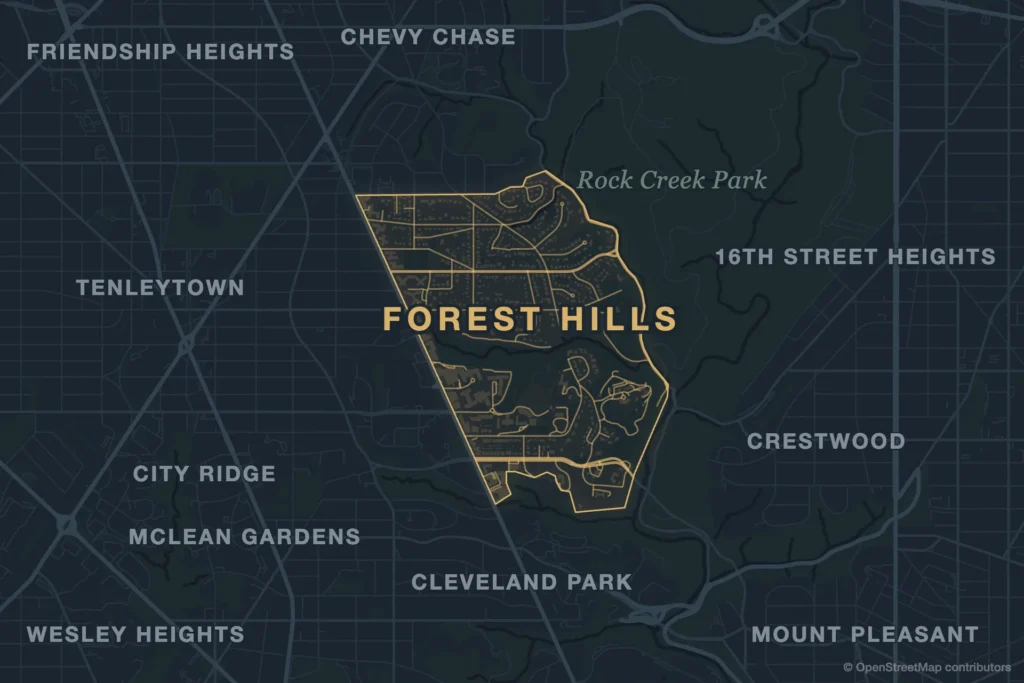
Living in Forest Hills

An Upper Northwest neighborhood between Connecticut Avenue and Rock Creek Park, where detached houses on wooded, hilly lots sit behind a line of condominium and co-op buildings close to two Red Line stations.

Forest Hills Market Snapshot

A high-level look at current pricing, demand, and sales activity in the Forest Hills real estate market.
$509,000

Median Sales Price

$467

Median Price Per Sq Ft

22

Median Days On Market

107

Annual Closed Sales

+5.6%

YoY Median Price Change

Forest Hills is a split market: condominiums and co-ops near Connecticut Avenue supply about two-thirds of sales, and detached houses toward Rock Creek Park supply nearly all of the rest. The snapshot covers every closed sale inside the neighborhood boundary over the trailing twelve months through September 2026 — 70 condominiums and co-ops, 36 detached houses, and 1 rowhouse. Price per square foot uses interior living area.

Across all home types the median sale was $509,000 at about $467 per square foot, with a median of 22 days on market and sales averaging 96% of original list price. The median rose about 6% from the prior twelve months. Within segments, the condo median fell about 13% to $332,000 and the detached median rose about 5% to $2.51 million.

Market data reflects recent 12-month activity. Individual buildings may vary.

What Would Your Home Sell For Here?

Get my personal read on your home’s value, built from recent sales nearby and the homes you’d compete with, not an algorithm. I reply within one business day. Free, and no obligation to list.

For Sale

Homes for Sale in Forest Hills

Every active Forest Hills listing, pulled live from Bright MLS.

Don’t see the right home?

We track private and off-market opportunities before they reach the MLS.

Recently Sold

Recently Sold in Forest Hills

Closed sales from the past 12 months — the comps that set today’s pricing.

Wondering what your home could sell for?

Get a pricing strategy built on these comps and current Forest Hills demand.

Living in Forest Hills

An overview of Forest Hills, from its Connecticut Avenue apartment buildings to its wooded streets beside Rock Creek Park.
Forest Hills lies on the east side of Connecticut Avenue in Upper Northwest DC, with Rock Creek Park behind it. The area on this page follows the DC tax office’s assessment neighborhood, which is longer than the neighborhood most people mean by the name. It runs along Connecticut Avenue from the Cleveland Park commercial strip north to Nebraska Avenue, so it also takes in the Van Ness apartment district and several Connecticut Avenue buildings that agents label Cleveland Park. Two kinds of housing sit side by side. Along and just off Connecticut Avenue are large condominium and co-op buildings, many from the 1950s and 1960s, including Van Ness East on Van Ness Street and Van Ness North on Veazey Terrace. They supplied about two-thirds of the past year’s sales. Behind them, the streets that wind toward Rock Creek Park hold detached houses on wooded, sloping lots, ranging from 1920s and 1930s houses to mid-century and recent designs. Retail is concentrated on Connecticut Avenue. The blocks around the Van Ness-UDC station have a Giant supermarket, restaurants and services, and the Cleveland Park strip at the southern end adds more restaurants and shops. Soapstone Valley Park cuts a wooded ravine through the middle of the neighborhood down to Rock Creek Park, and Hillwood Estate, Museum and Gardens is on Linnean Avenue. Transit is the neighborhood’s practical advantage. Two Red Line stations, Van Ness-UDC and Cleveland Park, sit on Connecticut Avenue at the western edge. Metrobus routes on the avenue include the C87 at Van Ness, the D70 between Chevy Chase and Farragut Square and the D72 from Van Ness-UDC to Lafayette Square. Drivers use Connecticut Avenue and the Rock Creek Park roads. Many of the larger apartment buildings have underground parking, and many houses have driveways or garages. I’m glad to explain how the condominium, co-op and detached-house markets differ in Forest Hills and to show you what is available in each.

Key Highlights:

  • Housing character — detached houses on wooded lots toward Rock Creek Park; 1950s and 1960s condominium and co-op buildings along Connecticut Avenue
  • Green space — Rock Creek Park on the east, Soapstone Valley Park through the middle, Hillwood's gardens on Linnean Avenue
  • Daily essentials — Giant supermarket, restaurants and services near Van Ness-UDC; more shops on the Cleveland Park strip
  • Transit — Van Ness-UDC and Cleveland Park stations on the Red Line; C87, D70 and D72 buses on Connecticut Avenue
  • Schools — Murch or Hearst Elementary, Deal Middle and Jackson-Reed High for much of the area; confirm by address
  • Market character — condominiums and co-ops at a median near $330,000; detached houses at a median of about $2.5 million

Forest Hills Real Estate FAQs

Insight into the nuances of buying and selling in one of the country’s most complex urban markets.

Detached houses on wooded, hilly lots beside Rock Creek Park, a line of condominium and co-op buildings on Connecticut Avenue, and Hillwood Estate, Museum and Gardens.
In Upper Northwest DC, between Connecticut Avenue and Rock Creek Park. The area on this page runs from the Cleveland Park strip north to Nebraska Avenue and includes Van Ness.
Van Ness-UDC and Cleveland Park, both on the Red Line, are on Connecticut Avenue at the neighborhood’s western edge. The D70 and D72 buses also run on Connecticut Avenue.
Condominium and co-op apartments in large buildings near Connecticut Avenue, and detached houses on the streets toward the park. Of 107 sales in the past 12 months, 70 were apartments and 36 were detached houses.
Over the 12 months through September 2026 the all-types median was about $509,000. Condominiums and co-ops had a median of about $332,000, and detached houses about $2.51 million.
Detached houses sold in a median of about a week, and condominiums and co-ops in a median of about 30 days. The median for all 107 sales was 22 days.
On Connecticut Avenue. The Van Ness blocks have a Giant supermarket, restaurants and services, and the Cleveland Park strip at the southern end has more restaurants and shops.
DCPS assignments vary across this area; much of it is zoned to Murch or Hearst Elementary, which feed Deal Middle and Jackson-Reed High, and the southern blocks may differ. Confirm every assignment for a specific address with the DCPS boundary locator.

Location & Neighborhood

East of Connecticut Avenue, between the Van Ness and Cleveland Park stations and Rock Creek Park.

This page uses the DC tax office’s Forest Hills assessment neighborhood, which is approximate and wider than common usage. Connecticut Avenue is the western edge, from around Macomb Street in Cleveland Park north to Nebraska Avenue. Rock Creek Park forms the eastern side. The southern blocks, around Ordway and Macomb Streets, are usually called Cleveland Park, and the middle is often called Van Ness. Connecticut Avenue, Van Ness Street and Veazey Terrace hold the apartment buildings; Linnean Avenue, Albemarle and Ellicott Streets hold the detached houses.

Two Red Line Stations Nearby

Connecticut Avenue carries nearly all of the neighborhood’s transit. Van Ness-UDC and Cleveland Park stations put the Red Line within walking distance of the apartment buildings, though the houses nearest Rock Creek Park are a longer, hillier walk away. The D70 and D72 buses run down Connecticut Avenue toward Dupont Circle, Farragut Square and Lafayette Square. Drivers use Connecticut Avenue or the park roads to reach downtown.

Errands center on the Van Ness blocks of Connecticut Avenue, with a Giant supermarket, restaurants and other services close to the station. The Cleveland Park strip at the southern end has more restaurants and small shops. The University of the District of Columbia’s campus is across the avenue, and Hillwood Estate, Museum and Gardens is a short walk east on Linnean Avenue.

Neighboring Area:

  • North Cleveland Park — west, across Connecticut Avenue
  • Cleveland Park — south and southwest, around the Cleveland Park station
  • Chevy Chase DC — north, beyond Nebraska Avenue
  • Crestwood — east, across Rock Creek Park
  • Woodley Park — south, down Connecticut Avenue

A Day In The Life - Snapshot

The quick details buyers ask about most.

Metro Access
Van Ness-UDC and Cleveland Park stations on the Red Line are on Connecticut Avenue at the western edge. Homes closest to Rock Creek Park are a longer, hillier walk from either.
Walkability
Apartment buildings near Connecticut Avenue are a short walk from a supermarket, restaurants and Metro. The house streets toward the park are hilly and quieter, with longer walks to the avenue.
Typical Home Types
Condominium and co-op apartments in large 1950s and 1960s buildings near Connecticut Avenue; detached houses from the 1920s onward on wooded lots toward Rock Creek Park.
Parking
Many large apartment buildings have underground parking, sometimes rented or sold separately; confirm for each unit. Many detached houses have driveways or garages.
Vibe
A busy avenue of mid-rise and high-rise buildings on one side, and winding, heavily wooded streets with houses on sloping lots toward the park on the other.
Best For
Buyers who want an elevator-building apartment near the Red Line or a detached house on a wooded lot, and who accept a hilly walk from the park-side streets.

In-Depth Market Analysis

Forest Hills Market Insights

How pricing trends, absorption rates, and inventory levels are shaping buying and selling

Inventory & Absorption

There were 107 closed sales in the 12 months through September 2026, compared with 100 the year before. Condominium and co-op sales slipped from 76 to 70, while detached sales rose from 21 to 36. Two buildings, at 2939 Van Ness Street and 3001 Veazey Terrace, produced 37 of the apartment sales. About a quarter of all sales were co-op units. The median time on market was 22 days.

Pricing Dynamics

The all-types median was about $509,000, up roughly 6 percent from $482,000. That rise reflects more detached sales in the mix, because the two segments moved in different directions. The condominium and co-op median fell from about $381,000 to $332,000 and its price per square foot from $442 to $399. The detached median rose from about $2.39 million to $2.51 million, with price per square foot up from $545 to $590.

Buyer Profile

Detached houses drew the firmest demand: a median of 7.5 days on market, and 23 of 36 closed at or above the original list price, compared with 6 of 21 a year earlier. Apartments were slower, with a median of about 30 days and 23 of 70 closing at or above original list. Apartment prices ranged from about $188,000 to $835,000, and detached houses from about $939,000 to $7.5 million.

Strategic Outlook

The detached segment tightened over the past year, with more sales, shorter marketing times and higher medians. The apartment segment softened in price while volume held up reasonably well, so buyers there have had more room to negotiate. In co-op buildings, monthly fees and what they cover weigh heavily on value and deserve a close comparison. These figures describe the past 12 months and are not a forecast.

Market Position Overview:

Inventory Level: Balanced with selective competition

Negotiation Environment: Moderate flexibility

Typical Days on Market: 25-45 (well-priced units)

Rental Demand: Consistent due to transit proximity

Long- Term Outlook: Stable, walkability-driven value

Forest Hills Housing & Architecture

Forest Hills combines large condominium and co-op buildings along Connecticut Avenue with detached houses of many eras on wooded lots near Rock Creek Park.
Van Ness East
Van Ness East, the condominium at 2939 Van Ness Street, was the most active building in the area, with 20 sales in the past 12 months. It stands east of Connecticut Avenue, a short walk from the Van Ness-UDC station.
Van Ness North
The building at 3001 Veazey Terrace, listed under the name Van Ness North, recorded 17 sales in the past 12 months. Like its neighbor on Van Ness Street, it is within a short walk of the Red Line and the Connecticut Avenue shops.
Connecticut Avenue Co-ops and Condominiums
Buildings on the 3600, 3700, 3800, 4000 and 4100 blocks of Connecticut Avenue add more apartments, including some co-op buildings. The buildings at 3601 and 3701 Connecticut Avenue together recorded 15 sales in the past 12 months.
Pre-War Detached Houses
Detached houses from the 1920s and 1930s, many in Tudor and Colonial styles, line the streets between Connecticut Avenue and the park. Detached houses of all eras sold at a median of about $2.51 million over the past 12 months.
Mid-Century and Contemporary Houses
Later houses, from mid-century designs to recent construction, are mixed in on the hillier, more wooded lots. Detached sales ranged from about $939,000 to $7.5 million over the past 12 months, with a median of 7.5 days on market.
Cleveland Park Blocks
The southern end of the area, around Ordway and Macomb Streets, is generally known as Cleveland Park. Twenty-one of the past year’s sales carried the Cleveland Park label in sales records, and the Cleveland Park station and commercial strip are at this end.

Nearby neighborhoods

Close to Forest Hills

Ready to Talk About Your Next Move?

We’ll listen first, then recommend a strategy that fits your goals and timing.