
Should You Wait for Lower Rates?

Is waiting for the ‘magic 5%’ really worth it? We break down the math to show why the cost of waiting often outweighs the savings of a slightly lower rate.
Mortgage rates update — Wardman Residential at Compass

Should You Wait for Lower Rates?

Mortgage rates have already dropped into the upper 5s twice this year. But after just a few days, they ticked back up into the low 6% range. If you saw that and thought, “Great. I missed it,” you’re not the only one.

A lot of buyers are treating the 5s like some kind of magic number. As if moving from 6.1% to 5.99% suddenly changes everything. And from a mindset perspective, it does feel different.

But here’s the part most people don’t actually run the math on.

The Payment Difference Isn’t What You Think

Let’s say you’re looking at a $500,000 home loan. At 6.1%, generally speaking, your principal and interest payment is roughly $3,030 per month. At 5.9%, it’s about $2,966 per month.

That’s a difference of only $64 a month.

Not $300.

Not $500.

Sixty dollars.

Let that sink in for just a moment.
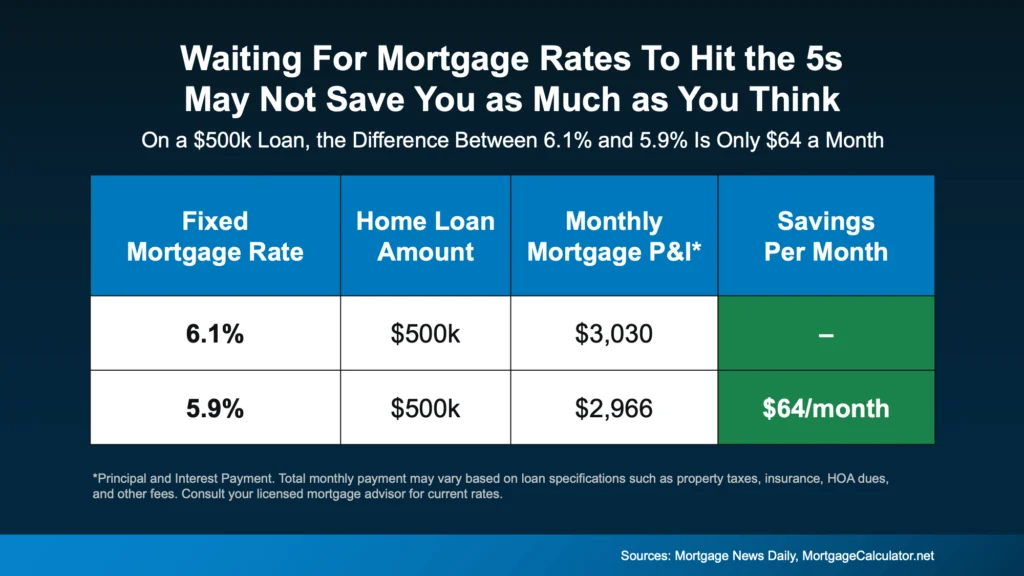
 

Yes, over time that $64 a month can add up. But it’s far from the dramatic swing many buyers imagine when they say they’re “waiting for the 5s.”

The psychological impact of seeing a 5 in front of your rate can feel big. The financial impact? It might be something you don’t even notice when it’s all said and done.

Experts Aren’t Predicting a Big Drop

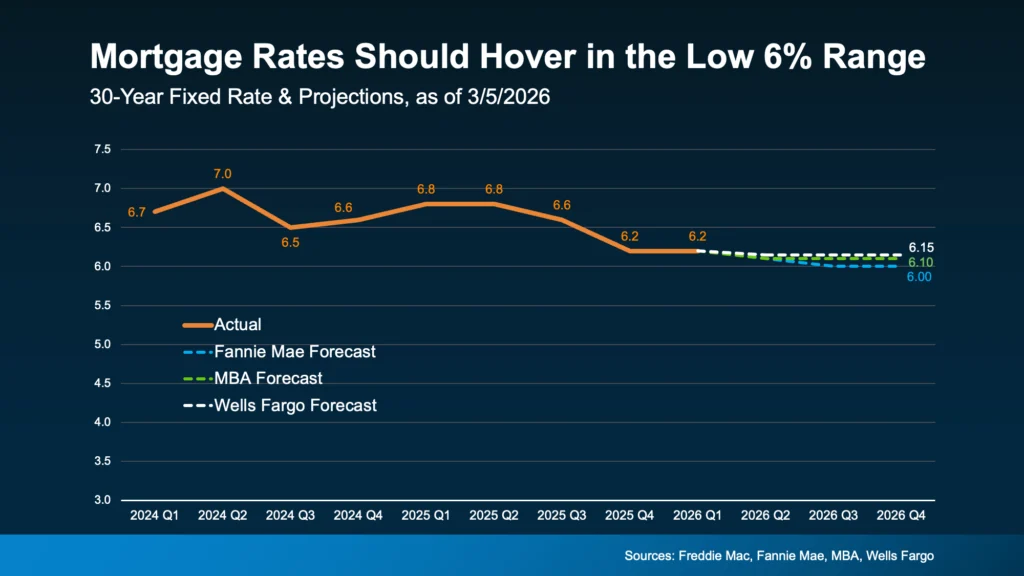
Another important piece to think about: most housing economists aren’t forecasting a long-term return to 5% territory anytime soon.

While rates will move up and down, likely hitting the high 5s here and there, the broader expectation is for mortgage rates to hover in the low 6% range this year, not stay in the 5’s or decline much more.
Wardman Insight
The Math: A small drop in rates (e.g., from 6.1% to 5.9%) often only results in a negligible monthly saving (roughly $60 on a $500k loan), which is easily wiped out if home prices rise while you wait.


While it certainly could happen, the reality is, waiting for a deep drop may not deliver the payoff you’re hoping for, if you’re holding out

The Bigger Question to Ask

Instead of asking, “Did I miss the 5s?” A better question is: “Does today’s payment work for me?”

If the monthly payment fits comfortably in your budget, and you’ve found a home that meets your needs, the difference between 6.1% and 5.9% likely isn’t the deciding factor. It might be one of them, but it shouldn’t be everything.

And remember, mortgage rates aren’t permanent. If they drop meaningfully later, refinancing is always an option. But you can’t refinance a home you didn’t buy.

Waiting Might Feel Safe, But It Isn’t Always Strategic

It’s natural to want the best possible rate. Everyone does. But sometimes buyers overestimate how much a rate in the high 5s will change things in today’s market.

Don’t miss the fact that rates have already come down. A year ago, they were in the 7s. Now? They’re hovering in the low 6s. And for a lot of people, that percentage point difference that’s already here is the real game changer.

If you paused your plans when rates were higher, now may be the right time to re-run your numbers. Not because rates are “perfect.” But because the monthly payment math might work better than you think, even with rates in the low 6s.

Before assuming you’ve missed your moment, take another look at the numbers.

You may find it never disappeared.

Bottom Line

While the idea of a “magic” interest rate is tempting, waiting for a specific number often means missing the window of opportunity before competition and prices surge. In a shifting market, a lower rate is only half the equation; the real value lies in securing the right property before the rest of the sidelines join the fray. Only a local expert can help you weigh the long-term cost of waiting against the immediate advantages of today’s inventory.

If you’re ready to stop watching the headlines and start looking at the numbers that actually matter for your move, let’s start a conversation. Reach out to your Wardman Residential team member today for a personalized analysis of your buying power. We are committed to helping you move forward with confidence, ensuring you have the data-driven expertise and local strategy needed to secure your next home on your terms.

Keep Reading

Related Posts

Explore more Wardman insights on the Washington, DC real estate market, neighborhoods, and homeownership strategy.

Brick colonial home on a leafy Montgomery County, Maryland street in autumn with a Wardman For Sale sign in the yard

Montgomery County Transfer Tax: What Sellers Actually Pay

On a $700,000 Montgomery County sale, transfer and recordation taxes total about $18,340, and the seller's default half is roughly $9,170. Here is the math by home type, plus the rules that shift it.
Brick colonial home in a Northern Virginia neighborhood in autumn with a Wardman Under Contract sign in the front yard

How Much Over Asking to Offer in Northern Virginia

Across Fairfax, Arlington, Alexandria and Loudoun, 34% of homes sold over asking last year, by a median 2.4%. Here is how much over asking to offer by home type, county and days on market.
Shoppers and families browse a string-lit outdoor holiday market at dusk

Must-See Holiday Markets Around the DMV This Year

Mulled wine, twinkling lights and handmade gifts: your 2026 guide to the best holiday markets across DC, Maryland and Northern Virginia, with dates, hours and costs for each.

A Smarter Approach to DC Real Estate

Work with a team that understands how pricing, preparation, and positioning come together to create exceptional results in today’s market.