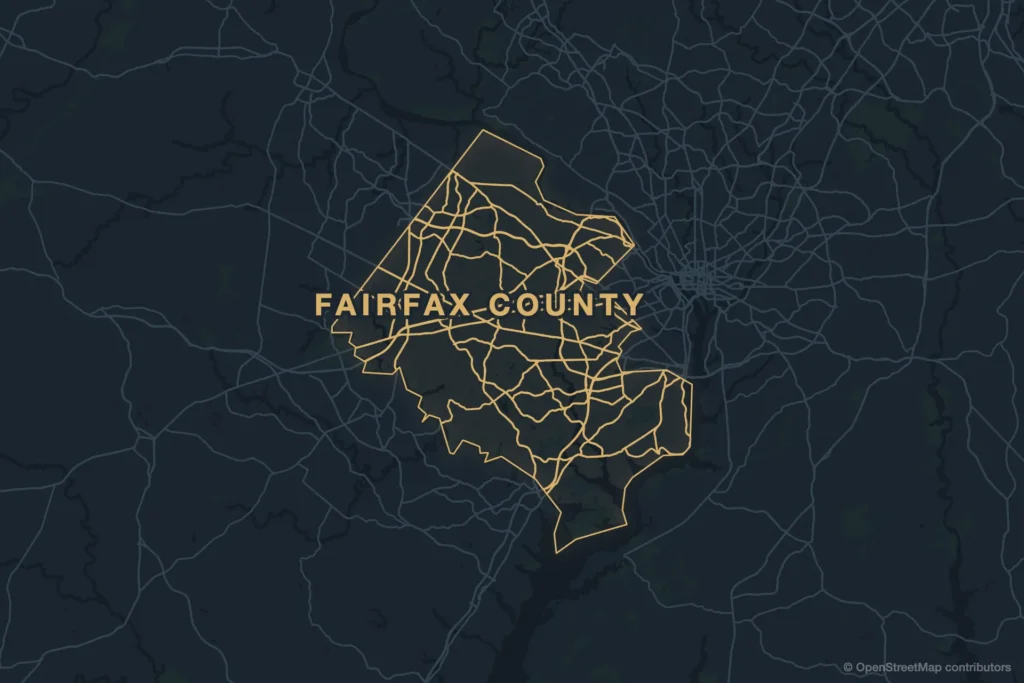
Living In Fairfax County

Northern Virginia’s largest county, with housing that ranges from condos and townhouses near Metro to suburban subdivisions, historic small towns, and homes on acreage.

Fairfax County Market Snapshot

A high-level look at current pricing, demand, and sales activity in the Fairfax County real estate market.
$759,000

Median Sales Price

$354

Median Price Per Sq Ft

8

Median Days On Market

11977

Annual Closed Sales

+1.9%

YoY Median Price Change

Fairfax County is a detached-house market with large townhouse and condominium segments. The snapshot covers every closed sale in Fairfax County (excluding the independent cities of Fairfax and Falls Church) over the trailing twelve months through September 2026 — 6,178 detached houses, 3,696 townhouses and semi-detached homes, and 2,091 condominiums. Price per square foot uses interior living area.

Across all home types the median sale was $759,000 at about $354 per square foot, with a median of 8 days on market and sales averaging 99% of original list price. The median rose about 2% from the prior twelve months. Within segments, the detached median held near $980,000 and the townhouse median held near $635,000.

Market data reflects recent 12-month activity. Individual buildings may vary.

What Would Your Home Sell For Here?

Get my personal read on your home’s value, built from recent sales nearby and the homes you’d compete with, not an algorithm. I reply within one business day. Free, and no obligation to list.

For Sale

Homes for Sale in Fairfax County

Every active Fairfax County listing, pulled live from Bright MLS.

Don’t see the right home?

We track private and off-market opportunities before they reach the MLS.

Recently Sold

Recently Sold in Fairfax County

Closed sales from the past 12 months — the comps that set today’s pricing.

Wondering what your home could sell for?

Get a pricing strategy built on these comps and current Fairfax County demand.

Living In Fairfax County

An overview of daily life, character, and what draws residents to the neighborhood.
Fairfax County is Northern Virginia’s largest jurisdiction, stretching from the inner suburbs just west of Arlington to the rolling countryside of western Fairfax. Within its borders are planned communities such as Reston, towns such as Vienna and Herndon, the Tysons urban center, and dozens of established suburban neighborhoods. Housing varies with geography. Closer to Arlington and along the Metro corridors, buyers find condominiums, townhouses, and older single-family neighborhoods. Farther west, subdivisions from the 1970s onward and newer construction dominate, and lots generally grow larger toward the county’s rural edges. The range runs from compact condos to estate homes on multiple acres. The county is known for its extensive park system, trails such as the W&OD and Cross County Trail, and a strong base of employment centers in Tysons, Reston, Fairfax, and the Dulles corridor. The Silver and Orange Lines, the Blue and Yellow Lines in the south, and VRE commuter rail serve different parts of the county. Fairfax County gives buyers an unusually wide choice of housing types, lot sizes, and commutes within a single jurisdiction.

Key Highlights:

  • Housing from Metro-area condos to homes on acreage
  • Planned communities such as Reston, plus towns like Vienna and Herndon
  • Tysons, Reston, and the Dulles corridor employment centers
  • Silver, Orange, Blue, and Yellow Line Metro and VRE service
  • Extensive parks and trails, including the W&OD and Cross County Trail
  • Fairfax County Public Schools; confirm boundaries by address

Fairfax County Real Estate FAQs

Insight into the nuances of buying and selling in one of the country’s most complex urban markets.

Fairfax County is served by Fairfax County Public Schools, one of the largest school systems in the country. School assignments are by address, so confirm any home with the FCPS boundary locator.
Significant differences exist. Inner Fairfax near Arlington is more urban; outer Fairfax is more suburban; western Fairfax is more rural. School district quality varies. Neighborhood selection is important.
In most of the county, yes. Some inner neighborhoods have better transit, but car ownership is essential for most residents. Metro access varies significantly by location.
Housing ranges from condos and townhouses to suburban single-family homes and estates. Much of the stock was built from the 1960s through the 1990s, alongside older close-in neighborhoods and newer construction.
Fairfax prices are higher than many surrounding areas due to schools. However, prices vary significantly by neighborhood and distance from DC.
It varies widely: urban and walkable around Tysons, Reston Town Center, and Mosaic; classic suburban in most subdivisions; and rural toward the western edge. Most areas are car-oriented, with Metro serving key corridors.
20-50 minutes depending on location. Inner Fairfax is closer; outer Fairfax is more distant.
Fairfax County’s range of housing, employment centers, parks, and transit has supported steady long-term demand. Pricing varies significantly by area, so compare recent sales in the specific neighborhood.

Location & Neighborhood

Northern Virginia’s largest county, from close-in suburbs to rural western acreage.
GENERAL BOUNDARIES:
  • NORTH: Loudoun County and the Potomac River
  • EAST: Arlington County, the City of Alexandria, and the Potomac River
  • SOUTH: Prince William County (Occoquan River)
  • WEST: Loudoun County and Prince William County

A County of Many Places

Fairfax County stretches from Arlington (east) to the Blue Ridge Mountains (west), encompassing approximately 400 square miles. The county includes urban-close neighborhoods near Arlington, established suburbs throughout the middle, master-planned communities like Reston, historic small towns like McLean, and rural areas in western Fairfax. The county is bisected by major corridors including Route 7, Route 50, Interstate 66, and the Dulles Toll Road. These create distinct neighborhoods and communities throughout the county. Metro access varies significantly by location, with Orange and Silver Line service in some areas.

Neighboring Area:

  • Arlington — 5-15 minutes
  • Alexandria — 10-20 minutes
  • Reston/Tysons — 20-40 minutes depending on starting point
  • Downtown DC — 30-45 minutes depending on location
  • Loudoun County — adjacent west

A Day In The Life - Snapshot

The quick details buyers ask about most.

Metro Access
Fairfax County’s Metro access varies by neighborhood. The Orange Line serves western areas including Vienna and other neighborhoods. The Silver Line serves Reston and areas toward Dulles. Many outer Fairfax neighborhoods have no direct Metro access and rely on cars or park-and-ride. Proximity to Metro is an important variable in neighborhood selection.
Walkability
Fairfax County’s walkability varies dramatically by neighborhood. Inner Fairfax near Arlington has good walkability. Master-planned communities like Reston have internal walkability within town centers. Suburban neighborhoods are less walkable, designed around car travel. Neighborhood selection significantly impacts your walkability experience.
Typical Home Types
Near Arlington and Metro, townhouses and garden-style condos are common. Moving west, Colonial and contemporary suburban homes from the 1970s onward dominate, and lots become larger toward the rural western edge.
Parking
Parking in Fairfax County is generally abundant. Most homes have driveways and garages. Street parking is common in neighborhoods. Parking is rarely a challenge. Car ownership is essential in most of the county due to limited transit.
Vibe
Mostly suburban and established, with walkable urban centers at Tysons, Reston Town Center, and Mosaic, historic town centers in Vienna, Herndon, and Clifton, and rural character in the western county.
Best For
Buyers who want a wide choice of housing types and lot sizes, access to major employment centers and Metro corridors, and extensive parks and trails.

In-Depth Market Analysis

Fairfax County Market Insights

How pricing trends, absorption rates, and inventory levels are shaping buying and selling

Inventory & Absorption

Inventory varies by area: close-in neighborhoods and those near Metro tend to be tighter, while outer areas and new-construction communities offer more choice. Well-priced homes in popular areas typically sell quickly.

Pricing Dynamics

Pricing depends heavily on location, lot size, age, and proximity to Metro and employment centers. Close-in and Metro-adjacent areas generally command higher prices than outer areas, and new construction carries a premium.

Buyer Profile

Buyers here often compare several parts of the county, weighing commute, Metro access, lot size, age of home, and school boundaries by address. Many are relocating from within the region for more space or a shorter commute to a Fairfax employment center.

Strategic Outlook

For buyers: narrow the search by commute, housing type, and budget, then compare recent sales within specific neighborhoods. For sellers: highlight updates, location, commute and Metro access, and outdoor space, and price to recent nearby sales.

Market Position Overview:

Inventory Level: Balanced with selective competition

Negotiation Environment: Moderate flexibility

Typical Days on Market: 25-45 (well-priced units)

Rental Demand: Consistent due to transit proximity

Long- Term Outlook: Stable, walkability-driven value

Fairfax County Housing & Architecture

Suburban subdivisions from the 1950s to today, townhouse communities, Metro-area condominiums, and planned communities such as Reston.
1960s–80s Subdivisions
Colonials, split-levels, and ramblers built from the 1960s through the 1980s make up much of the county’s detached housing.
Townhouse Communities
Townhouses from the 1970s onward are common in Reston, Burke, Centreville, and along the Fairfax County Parkway, offering a lower entry point than detached houses.
Metro-Area Condominiums
Condominium buildings cluster near Tysons, Merrifield, Vienna, and the Silver and Orange Line stations.
Planned Communities
Reston, begun in 1964, and Burke Centre are among the county’s large planned communities with trails, lakes, and village centers.
Large-Lot and Estate Homes
Great Falls, McLean, and parts of Clifton hold homes on large lots, setting the top of the market.
Transit
Silver, Orange, Blue, and Yellow Line stations serve the county, along with VRE commuter rail on the Manassas and Fredericksburg lines.

Nearby neighborhoods

Close to Fairfax County

Ready to Talk About Your Next Move?

We’ll listen first, then recommend a strategy that fits your goals and timing.