Living in Anacostia

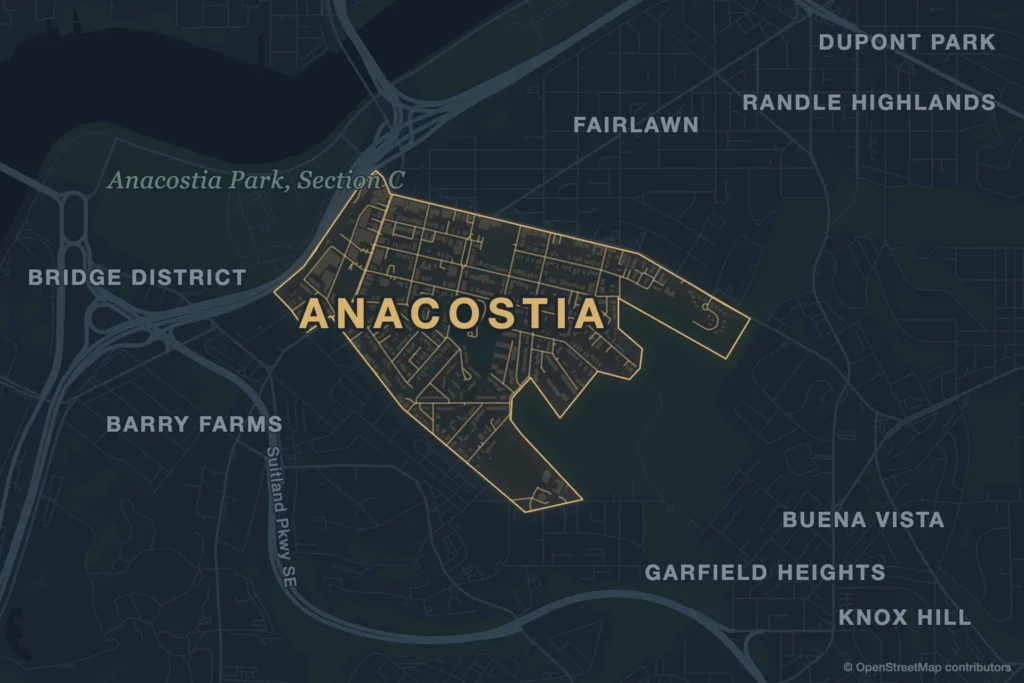
A Southeast DC neighborhood across the river from Navy Yard, built around the 1854 Uniontown street grid. Frame houses and brick rows climb the hill toward Cedar Hill, with the Green Line just west at Howard Road.

Anacostia Market Snapshot

A high-level look at current pricing, demand, and sales activity in the Anacostia real estate market.
$360,000

Median Sales Price

$228

Median Price Per Sq Ft

43

Median Days On Market

45

Annual Closed Sales

-5.3%

YoY Median Price Change

Anacostia is primarily a rowhouse and semi-detached market, with a meaningful share of detached frame houses and a small condominium segment. The snapshot covers every closed sale inside the neighborhood boundary over the trailing twelve months through September 2026 — 27 rowhouses and semi-detached homes, 12 detached houses, and 6 condominiums. Price per square foot uses interior living area.

Across all home types the median sale was $360,000 at about $228 per square foot, with a median of 43 days on market and sales averaging 91% of original list price. The median fell about 5% from the prior twelve months. Within segments, the rowhouse median fell about 6% to $360,000 and the detached median rose about 14% to $458,000.

Market data reflects recent 12-month activity. Individual buildings may vary.

What Would Your Home Sell For Here?

Get my personal read on your home’s value, built from recent sales nearby and the homes you’d compete with, not an algorithm. I reply within one business day. Free, and no obligation to list.

For Sale

Homes for Sale in Anacostia

Every active Anacostia listing, pulled live from Bright MLS.

Don’t see the right home?

We track private and off-market opportunities before they reach the MLS.

Recently Sold

Recently Sold in Anacostia

Closed sales from the past 12 months — the comps that set today’s pricing.

Wondering what your home could sell for?

Get a pricing strategy built on these comps and current Anacostia demand.

Living in Anacostia

An overview of Anacostia’s historic streets, its housing stock, parks, transit and everyday errands.
Anacostia lies on the east bank of the Anacostia River in Southeast Washington DC, directly across the 11th Street Bridge from Navy Yard and Capitol Hill. Its core was laid out in 1854 as Uniontown, one of the city’s early suburbs, and the Anacostia Historic District still holds much of that low-scale nineteenth-century streetscape. The area on this page follows the DC tax office’s Anacostia assessment neighborhood, which also takes in the Fairlawn blocks between the Anacostia Freeway and Minnesota Avenue up toward Pennsylvania Avenue. Housing is a mix of small-lot types. Two-story frame houses with front porches, many from the 1900s through the 1920s, line streets such as U, V and W Streets, Valley Place and High Street. Brick rowhouses and semi-detached houses from the 1920s through the 1940s fill in the hillside and the Fairlawn grid, and a small number of condominium units trade as well. Lots are modest and many houses have been renovated in the past decade, while others trade in original condition. Daily life centers on Martin Luther King Jr. Avenue and Marion Barry Avenue, the former Good Hope Road, where the two streets meet at the neighborhood’s commercial crossroads. The Anacostia Arts Center, the Anacostia Neighborhood Library and the Big Chair at V Street are local reference points. The Frederick Douglass National Historic Site at Cedar Hill, on W Street, sits on a hilltop inside the neighborhood, and Anacostia Park runs along the river just across the freeway. Fort Stanton Park and the Smithsonian’s Anacostia Community Museum are just to the south. The Anacostia Metro station on the Green Line is on Howard Road, just west of the boundary and a short ride from Navy Yard, L’Enfant Plaza and Gallery Place. Drivers use the 11th Street Bridge, the Anacostia Freeway and Suitland Parkway, and the Sousa Bridge on Pennsylvania Avenue is at the north end of the Fairlawn blocks. I’m glad to walk you through how the historic district rules, block-by-block condition and distance to Metro shape pricing here.

Key Highlights:

  • Housing character — frame houses from the 1900s to 1920s, brick rowhouses and semi-detached houses, a few condominiums
  • Green space — Anacostia Park along the river, Cedar Hill grounds, Fort Stanton Park just south
  • Daily essentials — shops and services on Martin Luther King Jr. Avenue and Marion Barry Avenue
  • Transit — Anacostia station on the Green Line at Howard Road; 11th Street Bridge and the Anacostia Freeway
  • Schools — DC Public Schools; Anacostia High School is on 16th Street SE; confirm assignments with the DCPS boundary locator
  • Market character — 45 closed sales in twelve months, median about $360,000, mostly rowhouses and frame detached houses

Anacostia Real Estate FAQs

Insight into the nuances of buying and selling in one of the country’s most complex urban markets.

Anacostia is known for its historic district, laid out in 1854 as Uniontown, and for the Frederick Douglass National Historic Site at Cedar Hill. The Big Chair on Martin Luther King Jr. Avenue is its best-known landmark.
It is in Southeast DC on the east bank of the Anacostia River, across the 11th Street Bridge from Navy Yard. This page covers the tax assessment neighborhood, which also includes the Fairlawn blocks toward Pennsylvania Avenue.
Yes. The Anacostia station on the Green Line is on Howard Road, just west of the boundary, with direct trains to Navy Yard, L’Enfant Plaza and Gallery Place.
Mostly two-story frame houses, brick rowhouses and semi-detached houses built from the 1900s through the 1940s, plus a small condominium segment. Of 45 recent sales, 27 were rowhouses or semi-detached and 12 were detached.
The median closed price over the twelve months ending September 30, 2026 was about $360,000, with sales from $65,000 to $750,000. Detached houses had a median near $457,500, based on 12 sales.
The median was 43 days on market, and rowhouses moved faster at a median of 35 days. Sellers typically received about 91 percent of the original list price.
Shops, cafes and services cluster on Martin Luther King Jr. Avenue and Marion Barry Avenue. Larger grocery and retail trips usually mean a short drive to Alabama Avenue or across the river.
The area is served by DC Public Schools, and Anacostia High School is on 16th Street SE. Assignments depend on the address, so confirm with the DCPS school boundary locator.

Location & Neighborhood

On the east bank of the Anacostia River in Southeast DC, across the 11th Street Bridge from Navy Yard.

The area on this page follows the DC tax office’s Anacostia assessment neighborhood. The Anacostia Freeway forms the west and northwest edge, with Anacostia Park and the river beyond it. Minnesota Avenue is the east edge of the northern section, which runs up through Fairlawn to Pennsylvania Avenue. The southern edge falls around Morris Road and the slopes below Fort Stanton Park. Martin Luther King Jr. Avenue and Marion Barry Avenue hold the shops and civic buildings, W Street leads to Cedar Hill, and the residential grid of U, V and W Streets and Valley Place climbs the hill between them.

Green Line and Two Bridges

The Anacostia station on the Green Line sits on Howard Road just west of the boundary, a few stops from Navy Yard, L’Enfant Plaza and Gallery Place. The 11th Street Bridge carries local traffic and a walking and cycling path to Navy Yard and Capitol Hill, the Sousa Bridge on Pennsylvania Avenue serves the Fairlawn blocks, and the Anacostia Freeway and Suitland Parkway handle regional trips.

Everyday errands run along Martin Luther King Jr. Avenue and Marion Barry Avenue, where small shops, cafes, banks, the Anacostia Arts Center and the neighborhood library are within a few blocks of each other. Full-size grocery stores are a short drive away on Alabama Avenue or across the river near Navy Yard and Capitol Hill, so most households plan larger shopping trips by car or bus.

Neighboring Area:

  • Navy Yard — northwest, across the 11th Street Bridge
  • Fairlawn — north, toward Pennsylvania Avenue and the Sousa Bridge
  • Randle Heights — southeast, toward Fort Stanton Park and Alabama Avenue
  • Barry Farm — southwest, beyond Suitland Parkway
  • Hillcrest — east, toward Naylor Road and Skyland Town Center

A Day In The Life - Snapshot

The quick details buyers ask about most.

Metro Access
Anacostia station on the Green Line is on Howard Road, just west of the boundary. Most of the historic core is within about a 15-minute walk; the Fairlawn blocks are farther.
Walkability
The blocks near Martin Luther King Jr. Avenue and Marion Barry Avenue are walkable for cafes, the library and services. Hillside streets are steeper, and full grocery trips usually need a car or bus.
Typical Home Types
Two-story frame houses with porches, brick rowhouses and semi-detached houses from the 1900s through the 1940s, a handful of newer infill houses and a small number of condominiums.
Parking
Street parking is the norm on most blocks. Some houses have rear alley parking pads or driveways, mainly on the wider hillside lots and in the Fairlawn grid.
Vibe
Low-rise frame and brick blocks on a hillside, a compact main-street crossroads with daytime activity, river parkland across the freeway and long views toward downtown from the higher streets.
Best For
Buyers who want a porch-front house or rowhouse near the Green Line and the river parks, and who accept street parking, historic district review and a drive for larger grocery trips.

In-Depth Market Analysis

Anacostia Market Insights

How pricing trends, absorption rates, and inventory levels are shaping buying and selling

Inventory & Absorption

Closed volume was light: 45 sales in the twelve months ending September 30, 2026, down from 73 in the prior twelve months. Rowhouses and semi-detached houses made up 27 of those sales, detached houses 12 and condominiums 6. The median time on market was 43 days, against 51 days a year earlier. With a sample this small, a handful of listings can shift the picture from one quarter to the next.

Pricing Dynamics

The median closed price was about $360,000, roughly 5 percent below the prior period’s $380,000, though with only 45 sales that change is a small-sample reading. Sales ranged from $65,000 to $750,000 and the median price per square foot was $228. Sellers typically received about 91 percent of the original list price, and 12 of the 45 sales closed at or above the original list price.

Buyer Profile

Demand was firmest for rowhouses and semi-detached houses, which had a median of $360,000 and sold in a median of 35 days, with 10 of 27 closing at or above the original list price. Detached houses carried a higher median of about $457,500 but took a median of 61 days. The six condominium sales had a median near $107,500 and none reached the original list price.

Strategic Outlook

Expect condition and location within the neighborhood to keep driving a wide spread of outcomes. Renovated houses near the historic core and the Metro station are likely to continue selling faster than properties that need work, and pricing that reflects recent closed sales matters given the gap between original list and sold prices. Low volume means the median can move without any real change in values.

Market Position Overview:

Inventory Level: Balanced with selective competition

Negotiation Environment: Moderate flexibility

Typical Days on Market: 25-45 (well-priced units)

Rental Demand: Consistent due to transit proximity

Long- Term Outlook: Stable, walkability-driven value

Anacostia Housing & Architecture

Nineteenth-century frame houses, early twentieth-century porch-front houses and brick rows on a hillside street grid above the river.
Anacostia Historic District
The historic district covers the old Uniontown grid, founded in 1854, and keeps a low-scale streetscape of frame houses and small commercial buildings. Exterior changes within the district go through the city’s historic preservation review, which buyers planning renovations should factor in.
Frame Porch-Front Houses
Two-story wood-frame houses with full-width front porches are the signature type on U, V and W Streets and the blocks around them. Many date from the 1900s through the 1920s, and condition ranges from fully renovated to original.
Brick Rowhouses and Semis
Brick rowhouses and semi-detached houses from the 1920s through the 1940s line the hillside streets and the Fairlawn grid. They were the largest group of recent sales, with a median price of about $360,000 across 27 closings.
Detached Hillside Houses
Detached houses sit on the higher streets toward Cedar Hill and Fort Stanton, some with driveways and wider lots. Twelve sold in the past twelve months at a median near $457,500, with a top sale of $750,000.
Condominiums
A small condominium segment includes units in small buildings, among them one on Naylor Road. Six units closed in the past twelve months, with prices from $65,000 to $440,000, so each sale should be read on its own.
Cedar Hill and Main Street
The Frederick Douglass National Historic Site occupies the Cedar Hill estate on W Street, which Douglass bought in 1877. Downhill, Martin Luther King Jr. Avenue and Marion Barry Avenue form the commercial spine, anchored by the Big Chair, first installed in 1959 and replaced with a replica in 2006.

Nearby neighborhoods

Close to Anacostia

Ready to Talk About Your Next Move?

We’ll listen first, then recommend a strategy that fits your goals and timing.