
Living In Silver Spring
Silver Spring Market Snapshot
Median Sales Price
Median Price Per Sq Ft
Median Days On Market
Annual Closed Sales
YoY Median Price Change
Silver Spring is primarily a detached-house market, with condominiums downtown and a smaller townhouse segment. The snapshot covers every closed sale inside the Silver Spring census-designated area over the trailing twelve months through September 2026 — 265 detached houses, 85 condominiums, and 47 townhouses and semi-detached homes. Price per square foot uses interior living area.
Across all home types the median sale was $649,000 at about $354 per square foot, with a median of 14 days on market and sales averaging 97% of original list price. The median rose about 3% from the prior twelve months. Within segments, the detached median held near $730,000 and the condo median fell about 2% to $300,000.
Market data reflects recent 12-month activity. Individual buildings may vary.
What Would Your Home Sell For Here?
Get my personal read on your home’s value, built from recent sales nearby and the homes you’d compete with, not an algorithm. I reply within one business day. Free, and no obligation to list.
For Sale
Homes for Sale in Silver Spring
See all Silver Spring listings
Don’t see the right home?
We track private and off-market opportunities before they reach the MLS.
Recently Sold
Recently Sold in Silver Spring
Closed sales from the past 12 months — the comps that set today’s pricing.
See more closed sales
Wondering what your home could sell for?
Get a pricing strategy built on these comps and current Silver Spring demand.
Living In Silver Spring
Silver Spring sits just north of the DC line along Georgia Avenue and has grown over the past two decades into one of Montgomery County’s most active downtowns. The Red Line station and the Paul S. Sarbanes Transit Center anchor a walkable core of restaurants, shops, offices, and apartment and condominium towers around Ellsworth Drive and Veterans Plaza.
Housing ranges widely. Downtown and near the Metro, buyers find high-rise and mid-rise condominiums and newer townhouses. Surrounding neighborhoods such as Woodside, Woodside Park, East Silver Spring, and North Hills of Sligo hold Colonials, Cape Cods, bungalows, and mid-century homes, mostly from the 1920s through the 1950s, on tree-lined streets.
Culture and recreation are strong draws: the restored 1938 AFI Silver Theatre, the Fillmore music venue, weekend events on Veterans Plaza, and restaurants spanning many cuisines. Sligo Creek Park and its trail run through the eastern neighborhoods, and Rock Creek Park is to the west.
The Red Line puts downtown DC about 20–25 minutes away, MARC commuter rail stops at the transit center, and the Purple Line under construction will connect Silver Spring to Bethesda and New Carrollton. Silver Spring offers a walkable downtown with a range of condos, townhouses, and single-family homes, typically at lower prices than Bethesda.
Key Highlights:
- Red Line station and transit center anchoring the downtown core
- Restaurants spanning many cuisines, plus the AFI Silver Theatre and the Fillmore
- High-rise condos downtown and 1920s–1950s homes in surrounding neighborhoods
- Sligo Creek Park and trail
- MARC commuter rail and the future Purple Line
- Typically lower prices than Bethesda
Silver Spring Real Estate FAQs
Insight into the nuances of buying and selling in one of the country’s most complex urban markets.
Which schools serve Silver Spring?
Are the schools in Silver Spring good?
Is the construction and revitalization ever going to finish?
Why is Silver Spring so much cheaper than Bethesda if they're both on the Red Line?
How has downtown Silver Spring changed?
What's the restaurant and entertainment scene really like?
Can you live car-free in Silver Spring?
Is Silver Spring's revitalization for real or just hype?
Location & Neighborhood
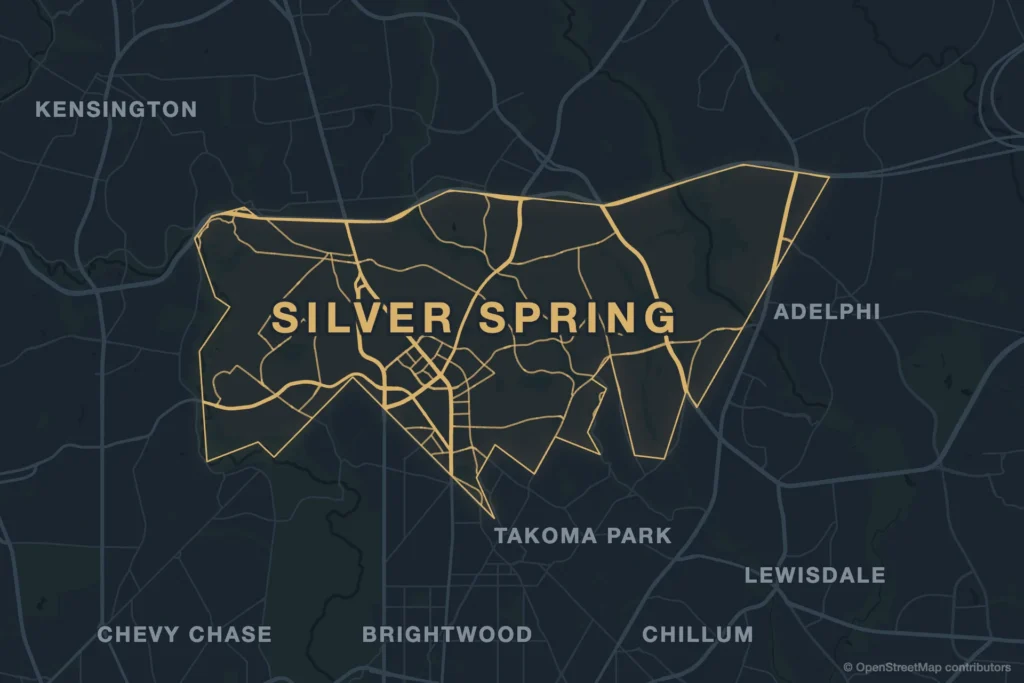
- NORTH: Wheaton and Four Corners
- EAST: Prince George’s County (New Hampshire Avenue area)
- SOUTH: Takoma Park and Washington, DC
- WEST: Rock Creek Park
Downtown Anchor Radiating to Residential
Silver Spring’s geography extends roughly 4 miles north-south and 3 miles east-west, with the downtown core (centered on the Red Line station) serving as the hub. The downtown area has undergone intensive mixed-use development, with residential, commercial, and cultural uses integrated vertically and horizontally. The area immediately surrounding downtown (typically within 10-minute walk) shows increasing density and development, with new townhomes and apartments transforming the landscape. Residential neighborhoods extending further out maintain more traditional suburban character, with single-family homes on modest lots.
The transformation is most visible in downtown and immediate surroundings; the overall impression is of a downtown-anchored community expanding upward in density rather than outward in sprawl. This urban development pattern creates genuine walkability in core areas while maintaining residential character in neighborhoods just blocks away.
Neighboring Area:
- Downtown Washington, D.C. — approximately 20-25 minutes via Red Line
- Bethesda — approximately 10 minutes south via Red Line
- Takoma Park — approximately 5-10 minutes north
- Glenn Dale — approximately 10 minutes east
- Northwest DC neighborhoods — approximately 10-20 minutes south via Red Line
A Day In The Life - Snapshot
The quick details buyers ask about most.
In-Depth Market Analysis
Silver Spring Market Insights
How pricing trends, absorption rates, and inventory levels are shaping buying and selling
Inventory & Absorption
Pricing Dynamics
Buyer Profile
Strategic Outlook
Market Position Overview:
Inventory Level: Balanced with selective competition
Negotiation Environment: Moderate flexibility
Typical Days on Market: 25-45 (well-priced units)
Rental Demand: Consistent due to transit proximity
Long- Term Outlook: Stable, walkability-driven value
Silver Spring Housing & Architecture
Condo Buildings
Condo Buildings in Silver Spring
Building-by-building guides with amenities, fees, recent sales and what's for sale now.
Nearby neighborhoods
Close to Silver Spring
Ready to Talk About Your Next Move?
We’ll listen first, then recommend a strategy that fits your goals and timing.